









News
Kimberly Guilfoyle’s Alleged $100K Texts to Trump Donor Spark Ambassador Controversy
Kimberly Guilfoyle sent Eric Deters a message saying: “Honey, please, I need you to get this done for me today.” Donald Trump nominated Kimberly Guilfoyle to serve as ambassador to Greece in December 2024.

Kimberly Guilfoyle, Donald Trump Jr.’s former fiancée and the US ambassador to Greece, faces fresh scrutiny after a report alleged she urgently asked a prominent Trump donor to pay a $100,000 American Express bill just days before her Senate confirmation hearing.
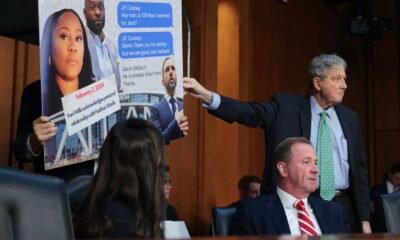
According to The Wall Street Journal, text messages exchanged between Guilfoyle and Eric Deters, a Kentucky attorney and former congressional candidate, show her repeatedly pressing him to settle the bill in July 2025.
The report has raised questions about the relationship between political donors and public officials, particularly because Eric Deters reportedly sought Kimberly Guilfoyle’s help in bringing personal legal and tax matters to the attention of senior Trump administration officials.
Guilfoyle’s lawyer has disputed the messages’ authenticity, although he reportedly did not provide specific details challenging them.
‘Honey Please’: The Alleged $100,000 Request
The reported exchange took place on July 3, 2025, six days before Kimberly Guilfoyle appeared before the Senate Foreign Relations Committee for her ambassadorial confirmation hearing.
According to the Journal, Kimberly Guilfoyle sent Eric Deters a message saying: “Honey, please, I need you to get this done for me today.”
The message allegedly included a document containing payment instructions for her American Express account.
She reportedly followed up by suggesting that Deters transfer the money directly to the credit card company.
“You could just send it here,” she allegedly wrote, adding that a wire transfer to American Express would list the credit card company as the recipient.
The report does not establish that Eric Deters ultimately paid the bill. In fact, he reportedly declined the request.
The episode has attracted attention because of its timing: Kimberly Guilfoyle was preparing for a key step towards becoming Washington’s representative in Greece.
View this post on Instagram
What Was the Trump Donor Allegedly Expecting in Return?
The Journal reported that Eric Deters offered to provide Kimberly Guilfoyle with as much as $1 million if she helped him bring his legal and tax concerns before senior Trump administration officials.
Eric Deters reportedly wanted assistance with two matters, including an effort involving an Ohio doctor who had traveled to Pakistan after facing charges related to alleged insurance fraud involving unnecessary surgeries on children.
He was also dealing with an Internal Revenue Service investigation concerning a tax deduction he had claimed in connection with the sale of an interest in his family business.
According to the report, Deters believed Guilfoyle could help him establish connections with influential administration figures.
However, when she allegedly asked for $100,000 urgently, he pushed back.
The Journal reported that Deters responded that he could not provide the money without risking his marriage.
Deters later told the publication that Guilfoyle had not delivered on her promises.
The reported exchange raises questions about the expectations in the relationship, but it does not, by itself, establish that Guilfoyle exchanged official action for money or committed wrongdoing.
‘You’ll Literally Cost Me My Ambassadorship’
The report also described messages in which Guilfoyle allegedly urged Deters to keep their communications private.
In one reported exchange, she asked him to stop documenting their discussions and instead contact her through Signal.
Another message, reportedly sent in January 2025, included the warning: “What a nightmare, you’ll literally cost me my ambassadorship stop writing.”
The alleged messages have become a focal point because Donald Trump nominated Kimberly Guilfoyle to serve as ambassador to Greece in December 2024.
She appeared before the Senate Foreign Relations Committee in July 2025, and the Senate confirmed her on September 18 in a 51-47 vote.
Her confirmation preceded her assumption of the diplomatic role, which placed her at the center of US-Greece relations.
Guilfoyle’s Team Pushes Back as Rubio Declines to Weigh In
Guilfoyle’s attorney, Jesse Binnall, told the Journal she disputed the messages’ authenticity. The report did not provide further details of her challenge.
A US Embassy official in Athens defended Guilfoyle’s professional record, saying she had undergone bipartisan Senate Foreign Relations Committee vetting and remained committed to representing the American people.
Secretary of State Marco Rubio, who was visiting Greece, declined to substantively address the report when questioned by journalists.
Marco Rubio criticized the assumption that published accounts should automatically be accepted as fact, saying that a report based on a source was not necessarily “the gospel.”
Eric Deters, meanwhile, has said he did not pay the bill despite the reported appeals.
Why the Report Is Drawing Attention
The controversy centers on more than an alleged credit card payment. It concerns the boundaries between private financial relationships, political fundraising, and access to government officials.
The reported messages describe a donor seeking help with personal matters while a prospective ambassador was allegedly requesting substantial financial assistance.
However, the messages’ authenticity has been disputed, and the reporting does not establish that any official action was taken in exchange for money.
For now, the allegations place Guilfoyle under renewed scrutiny as questions continue over her reported dealings with Deters and the circumstances surrounding the request.