









News
Gloria Steinem Dies at 92: Feminist Icon Who Changed America’s Conversation About Women Is Gone

Gloria Steinem, the pioneering journalist, writer and feminist activist who became one of the defining voices of the modern women’s rights movement, has died at 92.
Steinem died Wednesday, her foundation announced Thursday. For more than five decades, she challenged discrimination against women, fought for reproductive rights and helped build organizations that reshaped American political and cultural life.
Her death marks the end of an extraordinary era for one of the most recognizable figures in American feminism.
Gloria Steinem wasn’t simply a commentator on the women’s movement. She helped build it.
From Journalist to Face of a Revolution
Born on March 25, 1934, in Toledo, Ohio, Steinem grew up in a family that frequently moved because of her father’s work as an antique dealer. Her parents separated when she was 11, leaving her to help care for her mother.
After graduating from Smith College, Steinem began working as a journalist and freelance writer.
Her breakthrough came in 1963 when she went undercover as a Playboy Bunny for an exposé published in Show magazine. Her reporting, later known as “A Bunny’s Tale,” exposed low wages and sexist treatment faced by women working at the Playboy Club.
The assignment became an early example of Steinem’s ability to turn personal observation into a wider argument about women’s lives.
Ms. Magazine Became a Feminist Powerhouse
Gloria Steinem emerged as a major feminist voice during the social upheaval of the late 1960s.
She helped found New York magazine in 1968, but her activism accelerated after she attended an abortion speak-out in New York in 1969. Steinem had previously undergone an abortion in London when she was 22, at a time when the procedure was illegal in much of the United States.
In 1971, she co-founded Ms. Magazine, creating a publication that treated issues such as abortion, workplace discrimination, equal pay and domestic violence as central subjects rather than side topics.
The magazine became one of the most influential platforms of the women’s movement.
She Built a Movement Far Bigger Than Herself
Steinem’s influence extended far beyond journalism.
In 1971, she helped establish the National Women’s Political Caucus alongside Bella Abzug, Shirley Chisholm and Betty Friedan.
She was also involved in creating organizations including the Women’s Media Center, Voters for Choice, the Coalition of Labor Union Women and the Ms. Foundation for Women.
Her approach to feminism increasingly emphasized inclusion and the experiences of women of color.
Steinem explicitly credited Black women with influencing her understanding of feminism, arguing that women of color had played a foundational role in the movement.
Her Voice Never Lost Its Edge
Steinem became famous not only for activism but also for sharp, memorable observations about sexism, politics, marriage and reproductive freedom.
She rejected the idea that discrimination against women was inevitable and repeatedly connected reproductive autonomy with democracy.
Following the U.S. Supreme Court’s 2022 decision overturning Roe v. Wade, she argued that removing people’s ability to make decisions about their own bodies threatened democracy.
She also challenged the idea that feminism required women to follow a particular path.
At 66, Gloria Steinem married David Bale, father of actor Christian Bale. She described the decision as evidence that feminism was fundamentally about having the freedom to choose what was right at different stages of life.
Obama Gave Steinem America’s Highest Civilian Honor
Steinem’s impact eventually reached the highest levels of American public life.
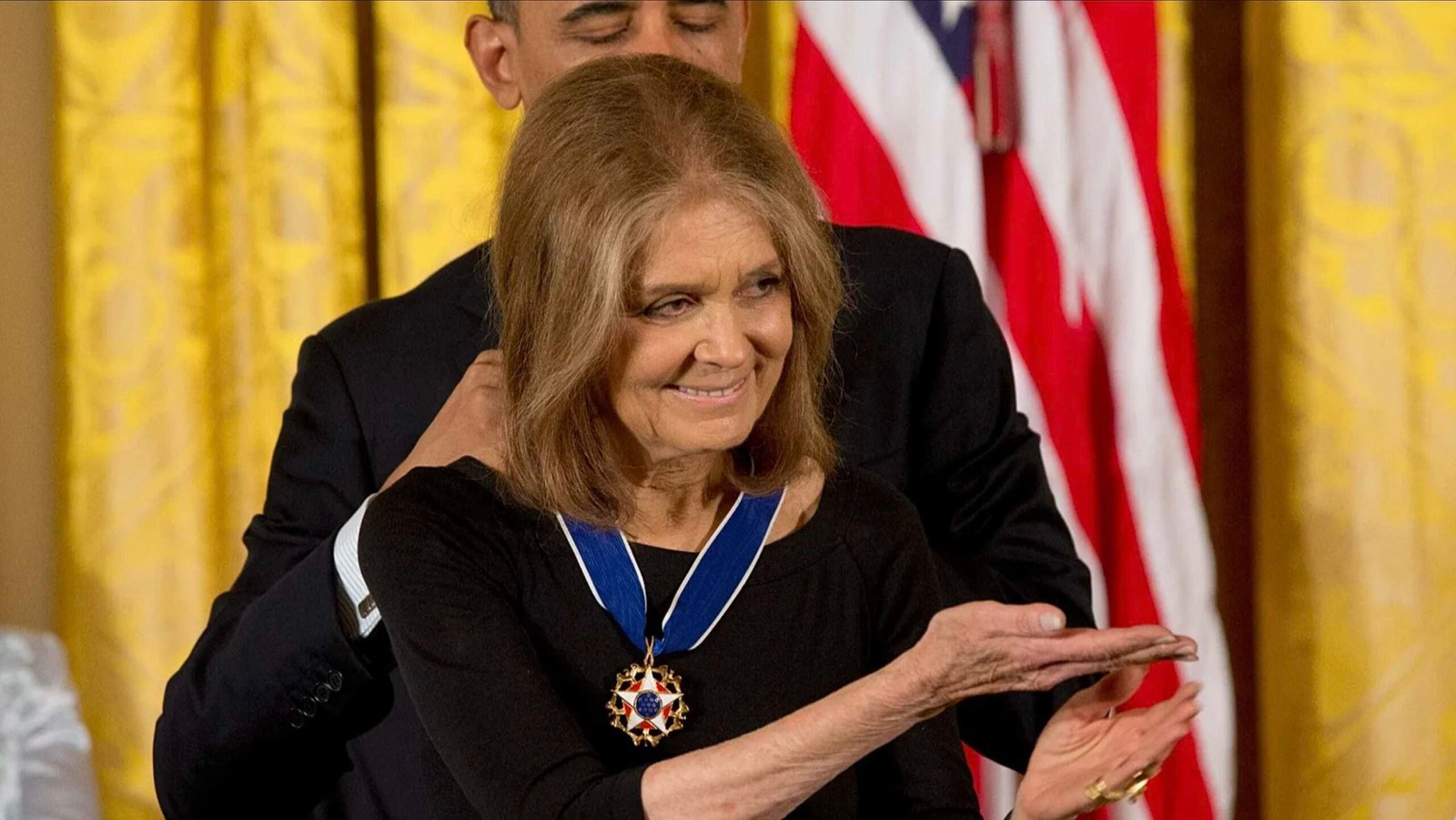
In 2013, President Barack Obama awarded her the Presidential Medal of Freedom, the country’s highest civilian honor.
Yet Steinem continued working well into her later years, writing books, appearing publicly and mentoring younger generations of activists.
Her final memoir, “An Unexpected Life,” is scheduled for release less than three weeks after her death. The book reflects on her childhood, political awakening and decades at the center of the feminist movement.
Gloria Steinem’s Legacy Is Still Being Fought Over
Steinem lived long enough to see enormous advances in women’s rights — and fierce resistance to many of those gains.
She watched women enter professions and political institutions once largely closed to them. She also witnessed the rollback of abortion protections and continuing battles over equality, representation and reproductive autonomy.
Her legacy was never universally accepted. Critics challenged aspects of her politics and the direction of the feminist movement she helped lead.
But even her critics could not erase her influence.
Gloria Steinem transformed feminism from a political cause into a mainstream national conversation.
She once described herself as an “entrepreneur of social change.”
That description may ultimately be among the simplest ways to understand her extraordinary life.
Gloria Steinem didn’t merely write about changing America.
She spent more than half a century trying to change it.