







News
Iran Claims It Captured U.S. Underwater Drone in Strait of Hormuz as Military Tensions Explode

Iran has claimed a dramatic intelligence coup in the Strait of Hormuz, saying its Revolutionary Guard seized a U.S. autonomous underwater drone operating near one of the world’s most strategically important waterways.
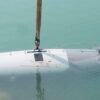
Iranian state media identified the unmanned submarine as an Anduril Dive-LD, a roughly 19-foot (5.8-meter) autonomous underwater vehicle designed for missions ranging from mine detection and seabed mapping to intelligence gathering and underwater infrastructure inspection. Images released through Iranian channels appear to closely match the American-built system.
But Washington has sharply downplayed the incident.
The Pentagon said a U.S. underwater drone had malfunctioned more than a day earlier while surveying regional waters and described it as an older model that carried neither sensitive data nor classified sonar or radar equipment.
The conflicting accounts have turned the incident into a new flashpoint in the already dangerous U.S.-Iran confrontation around the Strait of Hormuz.
Iran Says It Trapped a High-Tech U.S. Submersible
Iran’s Islamic Revolutionary Guard Corps said its naval forces had captured one of the U.S. military’s advanced unmanned submarines at the entrance to the Strait of Hormuz.
Iranian officials portrayed the vehicle as a major American technological asset and said the operation demonstrated Iran’s ability to detect and intercept sophisticated underwater systems.
However, the exact circumstances of the recovery remain unclear.
Reuters reported that the U.S. military confirmed the loss of an underwater drone but did not validate Iran’s description of the incident as a successful capture operation.
That distinction matters.
If the vehicle had already been disabled and drifting for more than a day, as U.S. officials say, Iran’s recovery would be very different from intercepting an operational American submarine drone during an active mission.
Even your smart submarine knows whose command it should be under.
It’s actually smarter than the President of the United States. 😎 pic.twitter.com/8Wzu3CFczN— Iran Embassy SA (@IraninSA) September 8, 2026
The Drone Is an Anduril Dive-LD
The vehicle appears to be Anduril’s Dive-LD, a large autonomous underwater vehicle developed by the California-based defense technology company.
The system is approximately 5.8 meters long and is designed for extended autonomous missions. Anduril says the Dive-LD can operate for up to 10 days and reach depths of approximately 6,000 meters (19,700 feet).
Its modular architecture allows different payloads and sensors for missions including mine countermeasures, seabed mapping, intelligence and surveillance, and inspection of underwater infrastructure.
Naval analysts examined images released by Iranian sources and noted several design features matching the Dive-LD, including its hull configuration, flood holes, mast, and distinctive tail structure.
Pentagon Says Iran Did Not Capture a Secret Weapon
The U.S. response has been notably dismissive.
According to the Pentagon and U.S. Central Command, the underwater drone malfunctioned more than a day before Iran announced its capture.
Officials said the vehicle was an older model and did not contain classified sonar or radar equipment. That suggests Washington does not believe the incident handed Iran access to highly sensitive American military technology.
Anduril has also described the Dive-LD as an “attritable” autonomous system — meaning it is designed for dangerous environments where losing the vehicle is considered an acceptable operational risk.
That explanation could help limit the perceived technological damage to the United States.
But it does not eliminate the intelligence value of obtaining an intact American-built autonomous underwater vehicle.
Could Iran Study the Technology?
That is now one of the biggest unanswered questions.
The Dive-LD is not a secret weapon in the traditional sense. Its broad capabilities and design have been publicly discussed, and analysts have already identified the platform from photographs.
But possessing the physical vehicle could potentially provide information about components, manufacturing techniques, sensors, communications architecture, or other details that are difficult to assess from public information.
Exactly what payload was installed on the recovered vehicle is not publicly known.
Nor is there evidence that Iran has extracted sensitive intelligence from it.
Any claims that the capture has compromised classified U.S. technology would therefore be premature.
Why the Strait of Hormuz Makes This So Dangerous
The location makes the incident much more significant.
The Strait of Hormuz is a critical global energy corridor, and the waters have become a major arena for U.S.-Iran military operations and surveillance.
Underwater drones are particularly valuable in such an environment because they can operate without placing sailors directly in danger.
They can search for naval mines, monitor maritime activity, map the seabed, and potentially inspect underwater infrastructure.
The United States has invested heavily in autonomous maritime technology because unmanned systems can perform dangerous missions at a fraction of the cost and risk of conventional crewed platforms.
A New U.S.-Iran Drone War Under the Surface?
The most important consequence may be psychological.
Iran can portray the incident as proof that it defeated an advanced American surveillance system. Washington, meanwhile, is emphasizing that the drone was old, malfunctioning, and carried no sensitive equipment.
Both narratives serve strategic purposes.
For Iran, the images of an American underwater vehicle in its possession provide powerful propaganda at a moment of intense confrontation.
For the United States, minimizing the loss’s technological value could prevent Tehran from turning the incident into a major intelligence victory.
One thing is already clear: the battle around the Strait of Hormuz is no longer taking place only above the water.