




News
Iran’s 10-Point Ceasefire Plan and Will Trump’s US Accept it?

A dramatic breakthrough unfolded as the United States and Iran agreed to a temporary two-week ceasefire just hours before a military escalation deadline set by Donald Trump. This, however, includes Iran’s 10-Point Ceasefire Plan.
The ceasefire agreement, reportedly mediated by Shehbaz Sharif, includes Iran’s willingness to reopen the strategically critical Strait of Hormuz, a move that could stabilize global energy markets, at least in the short term.
The White House described Iran’s proposal as a “workable basis” for negotiation, but major sticking points remain as per Iran’s 10-Point Ceasefire Plan.
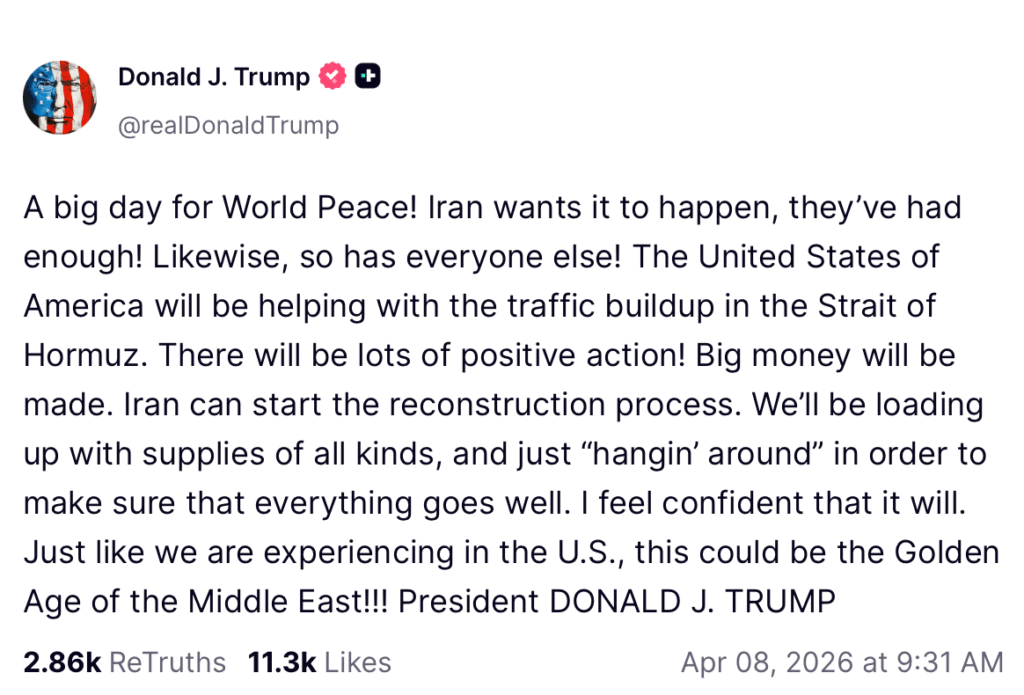
Donald Trump Taking a U-Turn on Truth Social
What Is in Iran’s 10-Point Ceasefire Plan?
Iran’s proposal outlines a sweeping set of demands that go far beyond a simple ceasefire. According to reports, the key conditions include:
-
Full lifting of US primary and secondary sanctions
-
Continued Iranian control over the Strait of Hormuz
-
Withdrawal of US military forces from the Middle East
-
Immediate end to attacks on Iran and its regional allies
-
Release of frozen Iranian financial assets
-
A binding resolution from the United Nations Security Council
One of the most controversial elements is Iran’s insistence on recognition of its nuclear enrichment program, though this clause appeared inconsistently across different versions of the proposal.
These demands signal Tehran’s attempt to secure long-term geopolitical and economic concessions rather than just a pause in hostilities.
How the US-Israel War on Iran Could Transform Gulf Security Forever
Why the Strait of Hormuz Is Central to the Deal
The Strait of Hormuz remains the most sensitive element of the proposal. This narrow waterway handles a significant portion of the world’s oil shipments, making it a critical artery for global trade.
Iran has suggested it would allow safe passage under its supervision and even introduce transit fees reportedly reaching up to $2 million per vessel, with funds earmarked for reconstruction.
However, critics warn that granting Iran control over the strait could disrupt global markets and shift the balance of power in the region.
It appears Trump just agreed to give Iran control of the Strait of Hormuz, a history-changing win for Iran.
The level of incompetence is both stunning and heartbreaking.
What on earth is happening? pic.twitter.com/5hEyg5KkZ5
— Chris Murphy 🟧 (@ChrisMurphyCT) April 7, 2026
Will the US Accept Iran’s Terms?
Despite the ceasefire, analysts remain skeptical that Washington will fully accept Tehran’s conditions. Lawmakers such as Chris Murphy have raised alarm over the implications of Iranian control over key international waterways, calling it potentially “cataclysmic.”
Trump has yet to directly endorse the plan’s details, but hinted at US involvement in managing shipping traffic in the region.
Experts believe Iran’s proposal may be a strategic opening position—setting high demands to gain leverage in future negotiations rather than expecting full acceptance.
Say hello to the new world superpower. pic.twitter.com/YoE9svaJ7c
— Iran Embassy SA (@IraninSA) April 8, 2026
Israel’s Role and Regional Tensions
The US-Iran ceasefire also involves Israel, with Prime Minister Benjamin Netanyahu backing the temporary halt in hostilities.
However, tensions remain high, particularly in Lebanon, where conflict involving Hezbollah continues. Israel has insisted that any long-term deal must ensure Iran no longer poses a nuclear or military threat.
Diplomatic talks are expected to continue, with Pakistan offering to host direct negotiations between US and Iranian officials. While Tehran has confirmed its participation, Washington has yet to finalize its involvement.
The coming weeks will determine whether this ceasefire evolves into a lasting peace agreement—or merely delays further conflict.