



News
Trump Sparks Outrage After Comments on Robert Mueller’s Death

Donald Trump is facing intense criticism after making controversial remarks about the death of Robert Mueller, who passed away at the age of 81.
Robert Mueller, a decorated Vietnam War veteran and former director of the Federal Bureau of Investigation, was widely respected for his decades of public service. However, Trump’s reaction to his death has sparked a wave of backlash across the political spectrum.
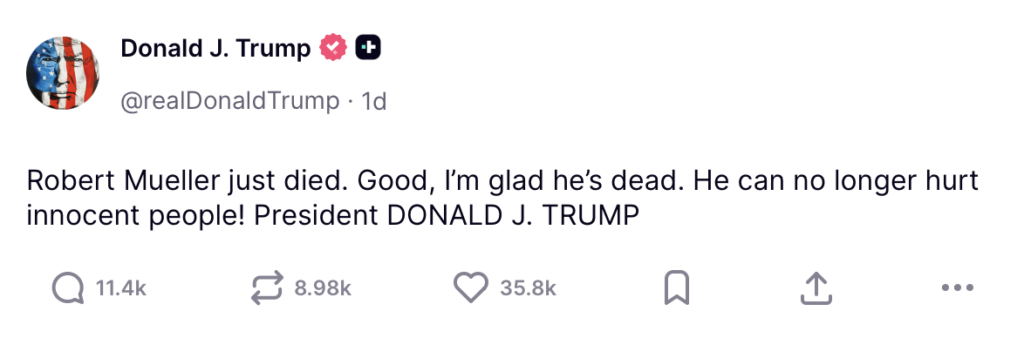
Donald Trump on Truth Social
Trump’s Remarks Trigger Bipartisan Criticism
Shortly after news of Robert Mueller’s death broke, Donald Trump posted a message expressing satisfaction over his passing. The statement quickly went viral, drawing condemnation from political figures, commentators, and members of both major parties.
Critics described the remarks as inappropriate and lacking basic respect for a public servant, especially given Mueller’s military service and long-standing role in US law enforcement.
The reaction has once again placed Trump’s rhetoric under scrutiny, with many questioning the tone and implications of his public statements.
Why Mueller Remains a Polarizing Figure
Robert Mueller played a central role in US politics during his tenure as special counsel investigating alleged interference in the 2016 presidential election.
The investigation, which lasted nearly two years, resulted in multiple indictments and convictions involving individuals connected to Trump’s campaign. While Mueller did not ultimately recommend criminal charges against Trump, the inquiry intensified political divisions in the country.
For Trump and his supporters, Robert Mueller’s investigation has long been viewed as politically motivated. For critics, Mueller remains a symbol of institutional accountability.
Trump’s Comments on Rob Reiner’s Death Trigger Bipartisan Backlash
Strong Reactions From Political Leaders
Prominent political figures and commentators were quick to condemn Trump’s comments. Critics argued that celebrating the death of a former public servant crosses a line of basic decency, regardless of political disagreements.
Some Republicans aligned with anti-Trump movements also voiced disapproval, highlighting concerns about leadership standards and public conduct.
Democratic leaders echoed similar sentiments, describing the remarks as damaging to the dignity of the presidency and reflective of broader political polarization.
Supporters Defend Trump’s Response
Despite the backlash, Trump’s allies have defended his remarks, arguing that his reaction reflects years of personal and political conflict stemming from the investigation.
Some supporters suggested that Trump’s comments should be understood in the context of the legal and political challenges he has faced over the years.
This divide underscores the deeply polarized nature of American politics, where even moments of mourning can become politically charged.
A Pattern of Controversial Statements
Trump has previously faced criticism for comments made after the deaths of prominent figures, often breaking with traditional expectations of respect for the deceased.
Such incidents have fueled ongoing debates about political norms, public discourse, and the evolving standards of leadership communication in the digital age.
The controversy highlights how quickly political narratives can escalate, particularly on social media platforms where statements are amplified instantly.
Analysts suggest that incidents like this contribute to growing divisions, shaping public perception not only of individuals but also of institutions and democratic values.
As reactions continue to unfold, the incident serves as a reminder of the powerful role language plays in politics. Whether viewed as candid expression or inappropriate rhetoric, Trump’s remarks have once again ignited a national conversation about respect, leadership, and accountability.