









News
NASA Discovers New Moon Crater After Asteroid-Sized Rock Slammed Into Lunar Surface

NASA has discovered a gigantic new crater on the Moon created by a space rock the size of a three- to six-story building in what scientists describe as an extraordinarily rare lunar impact.
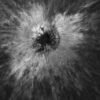
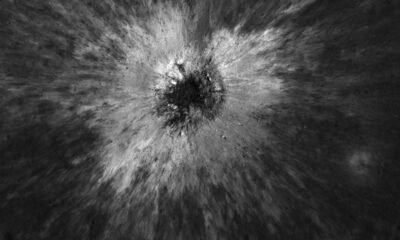
The crater, officially named McGetchin, stretches about 728 feet (222 meters) across and reaches approximately 141 feet (43 meters) deep. That makes it roughly the length of two football fields and the largest newly formed impact crater ever identified on the Moon or elsewhere in the solar system, according to NASA.
Even more remarkable, the violent collision happened in 2024 but was not immediately detected. NASA’s Lunar Reconnaissance Orbiter (LRO) eventually revealed the enormous scar while scientists were comparing years of lunar images.
Researchers say an impact capable of producing a crater this large may happen only about once a century or even less frequently, making the discovery an unusually valuable glimpse into how the Moon’s surface changes.
Giant Space Rock Slammed Into the Moon
Scientists believe the crater McGetchin formed on the Moon’s eastern edge sometime between April 11 and May 22, 2024.
The impactor was estimated to be about the size of a three- to six-story building. Unlike Earth, the Moon has virtually no atmosphere to slow down incoming objects or burn them up before they reach the surface.
When the object struck, it blasted enormous quantities of lunar material away from the impact site.
NASA says the resulting debris altered the surface over an area more than 60 miles (100 kilometers) wide. The crater itself, however, measures 728 feet across.
The crater was named after Thomas McGetchin, a pioneering lunar scientist and former director of the Lunar and Planetary Institute in Houston.
NASA Scientist Spotted a Strange Bright Spot
The discovery began with what seemed like a routine data check.
Robert Wagner, an image-processing specialist working with the Lunar Reconnaissance Orbiter Camera, was examining enormous maps generated from LRO data when a strange bright patch surrounded by a dark halo caught his attention.
The unusual pattern suggested that lunar material had been disturbed.
Wagner then compared older images with newer observations. The feature stood out dramatically from the surrounding terrain, prompting scientists to investigate further.
Scientists first discovered it on October 24, 2025, using images from LRO’s Wide-Angle Camera. Researchers subsequently turned to the spacecraft’s much higher-resolution Narrow-Angle Camera to examine the crater in detail.
The high-resolution observations confirmed the crater’s size, shape, and extensive ejecta deposits.
The Moon Around the Crater Got Colder
The impact did more than carve a giant hole into the lunar surface.
NASA scientists using the Lunar Reconnaissance Orbiter’s Diviner thermal instrument detected a roughly four-mile-wide cold region surrounding the crater. At night, this area was approximately 16 degrees Fahrenheit (9 degrees Celsius) cooler than nearby terrain.
Researchers say the cooling is linked to the impact disturbing the Moon’s loose surface layer, known as regolith.
The collision effectively “fluffed up” the regolith, making the material less dense. Because the loosened material retains heat less efficiently, the area cools more rapidly after sunset.
Scientists say the size of the cold region demonstrates that a major lunar impact can alter the Moon’s surface far beyond the crater itself. Such changes could potentially matter for future lunar vehicles and other equipment operating on the surface.
NASA Has Found Thousands of Lunar Changes
McGetchin is particularly important because the crater provides scientists with a fresh example of how quickly the lunar surface can change.
NASA’s LRO has been orbiting the Moon for more than 17 years and has identified at least 1,000 new impact craters, along with roughly 100,000 additional surface changes associated with impacts and ejected debris.
Most impacts are vastly smaller than McGetchin. NASA says the smallest new craters distinguishable in LRO imagery are around 30 feet across and can be created by rocks only around 43 inches wide.
The Moon’s surface is therefore far more dynamic than its ancient, seemingly frozen appearance suggests.
What Does This Mean for Future Moon Bases?
The discovery comes as NASA and other space agencies prepare for a new era of sustained lunar exploration.
One important question now is how far material thrown out by large impacts can travel and whether future lunar infrastructure could be exposed to it.
Mark Robinson, chief scientist for LRO’s cameras and lead author of one of the studies, said the next step is to calculate the potential risk of ejecta from new craters reaching planned lunar facilities.
The finding also challenges the idea that traces left by earlier lunar explorers will remain unchanged indefinitely. Robinson said the upper layer of lunar soil is overturned by impact ejecta on timescales of roughly 80,000 years, meaning historic footprints will eventually disappear beneath newly redistributed material.
For NASA, McGetchin is more than a spectacular new hole in the Moon. It is a warning written directly into the lunar landscape: the Moon may look still, but its surface is constantly being reshaped by the violence of space.