


News
Blood Moon 2026: Near-Total Lunar Eclipse Is About to Turn the Moon Red

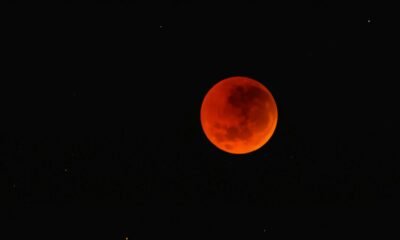
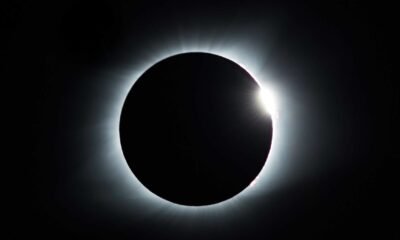
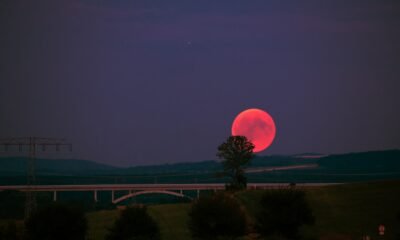
Skywatchers are getting another spectacular celestial event just weeks after a total solar eclipse darkened skies across parts of Europe. This time, the Moon is taking center stage as a near-total lunar eclipse prepares to paint the night sky a deep reddish-orange, hence the Blood Moon.
The eclipse will be visible across much of North and South America, making it a major viewing opportunity for millions. At its peak, approximately 96.2% of the Moon will be inside Earth’s darkest shadow.
And yes, that means the so-called “blood moon” effect.
When Will the Blood Moon Appear?
The lunar eclipse will begin at 9:23 p.m. ET on Thursday, when the Moon enters the outer portion of Earth’s shadow, known as the penumbra.
The more dramatic phase begins at 10:33 p.m. ET, when the Moon starts moving into the umbra, Earth’s darkest shadow. From the ground, it will look as though a giant bite is slowly being taken out of the lunar disk.
The eclipse reaches its peak at approximately 12:12 a.m. ET, when 96.2% of the Moon will be covered by Earth’s shadow.
The entire event concludes at around 3:01 a.m. ET, when the Moon finally leaves the outer edge of Earth’s shadow.
That makes the overnight spectacle particularly attractive to night owls — and anyone willing to set an alarm.
Why Does the Moon Turn Red?
Earth’s atmosphere causes the dramatic color.
As sunlight passes through Earth’s atmosphere, shorter blue wavelengths are scattered more strongly, while longer red and orange wavelengths continue through the atmosphere and reach the Moon.
The result is a reddish glow across the lunar surface.
That eerie appearance is why total lunar eclipses have earned the nickname “blood moon.”
Unlike a solar eclipse, however, you don’t need special protective eyewear. A lunar eclipse can be viewed safely with the naked eye, while binoculars or a telescope can reveal additional detail across the Moon’s surface.
Who Can See the Lunar Eclipse?
The continental United States is among the best-positioned regions for the event.
Most viewers throughout North and South America should be able to watch the eclipse unfold from beginning to end, although Alaska and the far northern reaches of Canada will miss portions of the spectacle.
Parts of Europe and Africa will also get a view, but the timing will be less favorable. In those regions, the eclipse will occur in the early hours of Friday, with the Moon setting before the event is complete.
Weather will ultimately determine who gets the clearest show.
Why Are Solar and Lunar Eclipses Happening So Close Together?
The timing isn’t a cosmic coincidence.
Solar and lunar eclipses commonly arrive in pairs because of the alignment of the Sun, Earth and Moon.
A solar eclipse occurs during a new moon, when the Moon moves between Earth and the Sun. Roughly two weeks later, the Moon reaches the opposite side of Earth during the full moon phase, creating the alignment needed for a lunar eclipse.
The striking visual relationship between the Sun and Moon is also partly due to an extraordinary cosmic coincidence: the Sun is roughly 400 times larger than the Moon but also about 400 times farther from Earth, causing both objects to appear remarkably similar in size from our planet.
The Next Eclipse Is Already on the Calendar
The celestial action won’t stop here.
According to NASA’s eclipse schedule, the next solar eclipse is expected on February 6, with visibility across parts of South America and Africa. Another lunar eclipse follows overnight from February 20 to 21, visible across much of the globe.
But for skywatchers in the Americas, the immediate attraction is clear: a nearly completely shadowed Moon, glowing red against the darkness.
So check the weather, find an unobstructed view of the sky, and prepare to look up.
The Blood Moon is coming.