






News
Rare Total Solar Eclipse to Grace Skies in August 2026, With Stunning Sunset Views Across Europe

Sky enthusiasts are preparing for one of the biggest astronomical events of 2026 as a total solar eclipse sweeps across parts of Europe and the North Atlantic on August 12, offering millions of people a chance to witness one of nature’s most dramatic spectacles.
According to NASA and astronomical experts, the eclipse will trace a path of totality across Greenland, Iceland, northern Russia, Spain, parts of Portugal and sections of the Atlantic Ocean, while millions more across North America, Europe and northwestern Africa will experience a partial solar eclipse.
Although viewers in the United States will not witness totality, residents in several states will still see the Moon cover a portion of the Sun, creating the appearance of a “bite” taken from the solar disk.
Spain prepares for a spectacular sunset eclipse
One of the most anticipated viewing locations will be eastern Spain and the Balearic Islands, where the eclipse will coincide with sunset, creating what astronomers describe as a rare “sunset eclipse.”
Observers in locations such as Mallorca are expected to witness totality just minutes before sunset, with the eclipsed Sun hovering only a few degrees above the horizon.
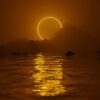
The combination of the Sun’s orange glow, the Moon’s silhouette and the brilliant white solar corona is expected to produce one of the most photogenic eclipse events in recent decades.
Experts also say viewers may have an opportunity to witness the Moon’s shadow lifting away from Earth immediately after totality ends, a phenomenon rarely visible during solar eclipses.
Partial eclipse visible across parts of North America
While Americans hoping for complete darkness will have to travel overseas, a partial solar eclipse will still be visible across portions of the United States and Canada.
States expected to witness at least part of the eclipse include Alaska, Maine, New York, Pennsylvania, Ohio, Michigan, Wisconsin, Illinois, Virginia, North Carolina, and several others across the northern and eastern regions.
During a partial eclipse, the Moon covers only part of the Sun, leaving a crescent-shaped solar disk visible throughout the event.
Unlike a total eclipse, observers in these regions must keep eclipse glasses on at all times while looking toward the Sun.
Safety remains the top priority
NASA continues to remind the public that looking directly at the Sun without proper eye protection can cause permanent vision damage.
Only certified eclipse glasses or handheld solar viewers meeting the ISO 12312-2 international safety standard should be used.
Ordinary sunglasses, camera filters, or homemade alternatives do not provide adequate protection.
Astronomers recommend inspecting eclipse glasses before use and replacing any that are scratched, damaged, or more than a few years old unless they have been stored properly.
Only observers located inside the narrow path of totality can safely remove eclipse glasses, and only while the Sun is completely covered by the Moon.
Perseid meteor shower adds bonus sky spectacle
The excitement won’t end with the eclipse. Just one night later, the annual Perseid meteor shower is expected to reach its peak under a new Moon, providing exceptionally dark skies for meteor watching.
NASA considers the Perseids one of the year’s most reliable meteor showers, capable of producing dozens of bright meteors each hour under ideal viewing conditions.
The combination of a total solar eclipse followed immediately by peak Perseid activity makes August 2026 one of the most significant months for amateur astronomers in years.
A rare opportunity for eclipse enthusiasts
Total solar eclipses occur somewhere on Earth roughly every 18 months, but each follows a unique path that often crosses remote oceans or sparsely populated regions.
The August 2026 event is attracting special attention because it passes over easily accessible European destinations, allowing travelers to combine tourism with eclipse viewing.
Astronomers expect hotels and viewing sites across Spain and the Balearic Islands to see heavy demand as eclipse chasers from around the world gather for the rare event.
With clear skies, proper planning and certified eye protection, the August 12 total solar eclipse promises to deliver one of the year’s most unforgettable celestial experiences.
















































Pingback: Solar Eclipse to Light Up Skies Across Europe and US