









News
SpaceX Falcon 9 Rocket Stage Crashes Into Moon, Creating New Lunar Crater
SpaceX explained that the impact was not intentional. Company officials said the combination of solar radiation pressure, gravitational influences from Earth and the Moon, and the rocket stage’s uncontrolled orbit gradually altered its flight path.

A discarded SpaceX Falcon 9 rocket stage is believed to have slammed into the Moon in an unplanned high-speed collision, marking one of the rare instances of human-made space debris impacting the lunar surface with a crater. While the event poses no threat to Earth, scientists say it offers a valuable opportunity to study the Moon’s geology and improve future space debris tracking.
The four-tonne upper stage, left drifting in space after launching Firefly Aerospace’s Blue Ghost 1 lunar lander in January 2025, was expected to strike the Moon at approximately 8,690 km/h (5,400 mph) on Wednesday. NASA and independent astronomers had tracked the object for months after gravitational forces and solar activity gradually altered its trajectory.
Unplanned lunar impact follows months of tracking
The Falcon 9 upper stage completed its primary mission by deploying Firefly Aerospace’s lunar lander under NASA’s Commercial Lunar Payload Services (CLPS) program. Unlike missions returning to Earth orbit, however, the rocket stage remained in deep space because the lunar mission required additional velocity to escape Earth’s gravity.
Over time, the discarded hardware drifted uncontrollably until astronomers identified that its orbit would inevitably intersect with the Moon.
NASA later confirmed there was effectively a 100% probability that the rocket body would impact the lunar surface.
Although observers equipped with advanced telescopes attempted to witness the event, no immediate visual confirmation was available because the predicted impact site was located near the Moon’s visible edge, making observation difficult.
NASA expects a fresh lunar crater
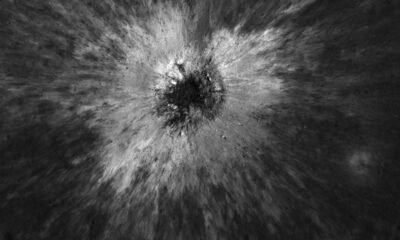
According to NASA, the SpaceX moon collision was expected to carve out a crater measuring roughly 18 metres (60 feet) wide and 4 metres (12 feet) deep.
The impact was also predicted to eject a substantial plume of lunar dust and rock, known as ejecta, into space. While the dust cloud may briefly become illuminated by sunlight, scientists said it would likely be too faint for naked-eye observation from Earth.
NASA plans to use data collected before and after the impact to understand better how artificial impacts affect the lunar surface.
The agency’s Lunar Reconnaissance Orbiter and South Korea’s Korea Pathfinder Lunar Orbiter, equipped with the ShadowCam instrument, are expected to search for the newly formed crater once lighting and orbital conditions permit imaging.
Researchers believe comparing pre- and post-impact images could improve scientific understanding of lunar soil behavior and assist future exploration missions.
No danger to Earth
NASA emphasized that the collision presents no risk to Earth or its population.
Unlike Earth, the Moon has virtually no atmosphere to slow incoming objects, meaning impacts from meteoroids occur regularly. Human-made impacts, however, are significantly less common.
Scientists estimate that a naturally occurring meteoroid carrying similar energy strikes the Moon roughly once every six days, making the Falcon 9 impact unusual but not unprecedented.
NASA officials also noted that observing controlled or predictable impacts helps improve computer models used to study crater formation and planetary geology.
Why the rocket hit the Moon
SpaceX explained that the impact was not intentional. Company officials said the combination of solar radiation pressure, gravitational influences from Earth and the Moon, and the rocket stage’s uncontrolled orbit gradually altered its flight path.
Because the upper stage had exhausted its fuel after completing the Blue Ghost mission, engineers had no ability to redirect or safely dispose of it.
NASA and SpaceX have since indicated they are discussing methods to reduce the likelihood of similar accidental lunar impacts during future deep-space missions.
Space debris remains a growing challenge
The incident has renewed attention on the increasing amount of debris beyond Earth’s orbit.
While most rocket stages used for Earth-orbiting missions either burn up during atmospheric re-entry or are deliberately directed into remote ocean regions, deep-space missions present more complicated disposal challenges.
Thousands of inactive spacecraft, rocket stages, and fragments currently orbit Earth or traverse cislunar space, requiring constant monitoring to prevent collisions with operational satellites and exploration missions.
Astronomers say the latest impact highlights the importance of improving end-of-mission disposal strategies as lunar exploration accelerates.
Not the first human-made impact
Artificial objects have struck the Moon before.
In 2009, NASA intentionally crashed a rocket stage into the lunar surface during the LCROSS mission to study water ice hidden inside permanently shadowed craters.
More recently, a Chinese rocket stage unintentionally impacted the Moon in 2022 after completing a lunar mission.
Several lunar landing attempts have also ended in accidental crashes, including Russia’s Luna-25 mission in 2023, India’s Chandrayaan-2 lander in 2019 and Israel’s Beresheet spacecraft during the same year.
Scientists note that while these events create localized disturbances, they also provide valuable research opportunities by exposing fresh lunar material beneath the surface.
As global interest in returning humans to the Moon grows, researchers believe each impact—planned or accidental—offers new insights into lunar science while underscoring the need for responsible spacecraft disposal practices.












































Pingback: A Six-Storey Asteroid Hit the Moon - NASA Just Found the Crater