









ISB Students Take Deep Dive Into Sikkim’s Organic Farming

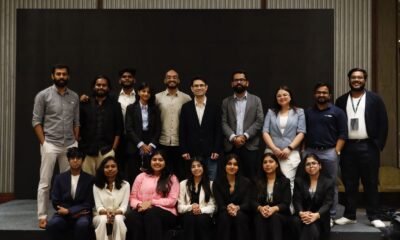
Sikkim’s organic farming model came under the spotlight as 40 students from the Indian School of Business led by Professor Ashwini Chhatre travelled across the Himalayan state, meeting farmers, agricultural experts and policymakers during an intensive five-day field study.
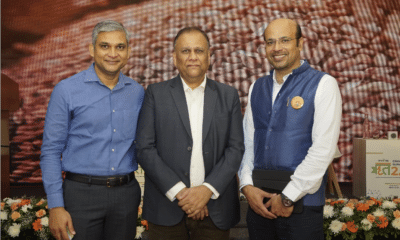
The delegation from ISB’s Hyderabad and Mohali campuses also met Sikkim Governor Om Prakash Mathur at Lok Bhavan on Friday, where students shared their observations from the agricultural study tour and discussed how technology could transform farming in the state.
The visit placed a sharp focus on the future of organic agriculture in Sikkim, including the potential role of artificial intelligence, drones and other modern technologies.
ISB Students Meet Sikkim Governor
The 40-member delegation was led by Professor Ashwini Chhatre of the Indian School of Business’ Bharti Institute of Public Policy and Professor Abhijeet Parmar.
During the five-day tour, the students travelled to different parts of Sikkim and interacted directly with farmers, farmer producer organisations, agricultural scientists and experts from Krishi Vigyan Kendras.
Rather than examining agriculture only from a classroom or policy perspective, the field study gave students an opportunity to understand the challenges faced by farming communities on the ground.
Their observations highlighted the importance of cooperation between government agencies and farmers in sustaining Sikkim’s organic agriculture ecosystem.
Why Sikkim’s Organic Farming Model Stood Out
According to the Lok Bhavan statement, the students found that strong coordination between farmers and the government has played an important role in the state’s success with organic farming.
Sikkim has long positioned itself around chemical-free agriculture, creating a distinctive model that has attracted attention nationally and internationally.
Governor Mathur described the state as a model of organic farming for India and the world, while urging the students to think about how scientific advances can complement traditional farming knowledge.
The challenge now is to make agriculture more productive and economically sustainable without undermining the principles that made Sikkim’s model distinctive.
AI and Drones Could Transform Farming
One of the strongest recommendations emerging from the students’ field study was greater adoption of modern technology.
The delegation suggested using artificial intelligence and drones to modernise agriculture and strengthen organic farming practices.
AI-based tools could potentially help farmers analyse crop conditions, monitor agricultural patterns and improve decision-making, while drones could support field monitoring and other precision-agriculture applications.
For a mountainous state such as Sikkim, technology could become particularly valuable in tackling difficult terrain and improving access to agricultural information.
The students also highlighted another major challenge: crop protection from wild animals.
Finding practical ways to prevent wildlife from damaging crops remains an important concern for farmers, and the delegation called for stronger solutions.
Women’s Empowerment and Rural Development
The ISB students also praised Sikkim’s culture, natural environment and efforts toward women’s empowerment.
Their observations extended beyond agricultural production, reflecting the wider social and economic ecosystem surrounding rural development.
The interaction demonstrated how agricultural policy, technology, gender empowerment and farmer incomes are increasingly interconnected.
Governor Calls for Science and Tradition to Work Together
Governor Om Prakash Mathur encouraged the students to combine modern scientific methods with traditional agricultural knowledge to increase farm productivity and improve farmers’ incomes.
He also urged the delegation to document its experiences through writing and use its knowledge to contribute to the broader goal of building a developed India by 2047.
The governor also praised Sikkim’s younger generation for approaching even seemingly small tasks with passion, describing that attitude as an important strength for the country’s future.
Sikkim’s Agriculture Faces Its Next Test
The ISB field study comes at a critical moment for agriculture, as climate pressures, technology and changing rural economies force traditional farming systems to adapt.
For Sikkim, the next challenge may be finding the right balance: preserving its organic identity while embracing AI, drones and modern scientific tools.
The students’ recommendations suggest that the state’s next agricultural chapter could be defined not by choosing between tradition and technology, but by making the two work together.