






News
Tyler Robinson Pleads Not Guilty as Charlie Kirk Murder Case Heads Toward Death Penalty Trial

The murder case against Tyler Robinson has taken a dramatic turn after a Utah judge ruled that the accused killer of conservative activist Charlie Kirk must stand trial, clearing the way for prosecutors to pursue the death penalty if he is convicted.
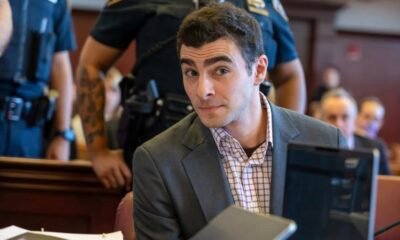
Tyler Robinson, 23, pleaded not guilty to all seven charges after District Judge Tony Graf found prosecutors had presented sufficient probable cause to move the case forward. The ruling came after a lengthy preliminary hearing in which prosecutors laid out DNA, video, alleged admissions and other evidence they say connects Robinson to the fatal shooting.
Tyler Robinson Faces Capital Murder Trial
The decision means Robinson will face trial on aggravated murder and six other charges, including firearm-related offenses, obstruction of justice and witness tampering.
Aggravated murder is the charge that potentially exposes Tyler Robinson to the death penalty under Utah law. Prosecutors have already announced that they intend to seek capital punishment if he is found guilty.
The judge’s ruling, however, does not mean Tyler Robinson has been found guilty. It establishes only that prosecutors presented enough evidence for the case to proceed to a full trial, where the burden of proof will be substantially higher.
Prosecutors Say Evidence Against Robinson Is Overwhelming
During closing arguments, Utah County prosecutors portrayed the case as one supported by multiple independent pieces of evidence.
Prosecutor Ryan McBride pointed to surveillance footage that allegedly showed Tyler Robinson taking up a position before the shooting. Prosecutors also cited DNA they say was recovered from the rifle believed to have been used in the attack.
Investigators have additionally presented alleged communications and statements involving Robinson and his former roommate and romantic partner, Lance Twiggs. Prosecutors contend those communications reveal Robinson’s involvement in the killing and his efforts to influence what Twiggs told investigators.
The prosecution has also argued that a handwritten note and other messages demonstrate planning and provide clues about Robinson’s alleged motive.
View this post on Instagram
The Death Penalty Fight Was Central to the Hearing
One of the biggest battles in court centered on whether Robinson’s alleged actions created a sufficiently serious danger to other people to support the aggravated murder charge.
Prosecutors argued that Robinson allegedly fired from more than 400 feet away toward Kirk while thousands of people surrounded the outdoor event at Utah Valley University.
Their argument was straightforward: even if Kirk was the intended target, a high-powered rifle fired into a densely populated gathering could have struck someone else.
Defense attorney Staci Visser countered that prosecutors were overstating the evidence. The defense emphasized that only one shot was fired and only Kirk was killed, arguing that prosecutors had not demonstrated the required level of danger to other people.
Prosecutors Allege Political Motive
The prosecution has also attempted to establish a motive connected to Charlie Kirk’s political views.
Kirk, a prominent conservative activist and co-founder of Turning Point USA, was killed while speaking at Utah Valley University on September 10, 2025.
Prosecutors allege Robinson strongly opposed Kirk’s views, particularly his positions concerning LGBTQ+ and transgender issues. They have argued that Robinson’s relationship with Twiggs, who prosecutors described as transgender and transitioning at the time, formed part of the context surrounding the alleged motive.
The defense has challenged that interpretation, arguing that prosecutors are drawing conclusions about Robinson’s state of mind that the evidence does not definitively establish.
Kirk Family Says Ruling Is a Step Toward Justice
Kirk’s family welcomed the decision allowing the case to proceed.
In a statement, the family described the ruling as an important step in its pursuit of justice, while acknowledging the enormous personal cost of the case.
The statement specifically highlighted Kirk’s children, who will grow up without their father.
Kirk’s widow, Erika Kirk, and his parents were present in court during the emotionally charged proceedings. The family has continued to follow the case as prosecutors seek the maximum possible punishment.
What Happens Next?
With the probable-cause stage now complete, the case moves toward trial proceedings. Robinson remains presumed innocent unless and until prosecutors prove the charges against him beyond a reasonable doubt.
The case has already become one of the most closely watched political-violence prosecutions in the United States, and the potential death penalty is likely to make the forthcoming trial even more consequential.
For prosecutors, the challenge will be to turn the evidence presented during the preliminary hearing into proof that meets the much higher standard required for conviction. For the defense, the focus will be on challenging the prosecution’s interpretation of the DNA, video, alleged admissions, motive and aggravating circumstances.
The next major stage could determine whether the prosecution can ultimately turn its allegations into a capital murder conviction.