
Trump Presidency
US F-35 Makes Emergency Landing After Iran Mission, Raising Questions Over Air Combat Risks

A US F-35 stealth fighter jet was forced to make an emergency landing at a military base in the Middle East following a combat mission over Iran, according to officials from US Central Command (CENTCOM).
The aircraft landed safely, and the pilot is reported to be in stable condition. A formal investigation into the incident is currently underway, with authorities yet to confirm the exact cause of the emergency diversion.
The development comes amid escalating tensions in the ongoing US-Iran conflict, which has seen intensified military operations since late February 2026.
Reports Suggest Possible Enemy Fire
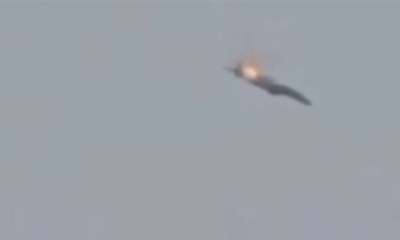
While US officials have not confirmed the reason for the emergency landing, multiple reports, citing unnamed sources, suggest the aircraft may have been struck during the mission.
Iran’s Islamic Revolutionary Guard Corps (IRGC) has claimed responsibility for targeting a US aircraft, releasing statements alongside purported video footage. However, these claims have not been independently verified.
If confirmed, the incident would mark a significant moment in modern air combat, as there have been no officially verified cases of an F-35 being hit by enemy fire since its deployment in active combat operations began in 2018.
Laura Loomer Slams Lockheed Martin’s F-35 Program as ‘Woke Waste’, Echoing Musk’s Critique
High-Stakes Conflict Intensifies
The emergency landing highlights the growing risks faced by military aircraft operating in contested airspace. Since the conflict began on February 28, 2026, the United States has conducted thousands of strikes targeting Iranian military infrastructure.
According to US defense officials, operations have focused on:
-
Destroying missile launch systems
-
Weakening Iran’s defense industry
-
Targeting naval assets, including submarines and mine-laying vessels
-
Preventing nuclear weapons development
Despite these efforts, senior military leaders acknowledge that Iran retains significant missile capabilities.
View this post on Instagram
Rising Military Losses and Damage Reports
The broader conflict has already resulted in multiple reported losses and incidents involving US military assets.
Officials indicate that:
-
Approximately a dozen MQ-9 Reaper drones have been lost
-
Several KC-135 refueling aircraft were reportedly damaged in missile strikes
-
A previous friendly fire incident led to the downing of three US fighter jets
In addition, at least 13 US service members have been killed and nearly 200 injured since hostilities began.
On the Iranian side, local reports suggest over 1,400 fatalities and more than 18,000 injuries, underscoring the human cost of the conflict.
Debate Over F-35 Vulnerability
The incident has also reignited discussions about the capabilities and limitations of stealth aircraft like the F-35.
While the jet is designed to evade radar detection using advanced materials and design, experts note that newer air defense systems, particularly those relying on infrared tracking rather than radar, may present new challenges.
These systems can detect heat signatures without emitting signals, making them harder to identify and counter during flight operations.
Military analysts say such evolving threats could reshape how modern air warfare is conducted, especially in regions with advanced or adaptive defense networks.
US Maintains Strategic Objectives
Despite the incident, US officials have reiterated that their strategic objectives in the region remain unchanged.
Defense leaders continue to emphasize a focus on weakening Iran’s military capabilities and preventing it from acquiring nuclear weapons. There is currently no defined timeline for the end of operations.
President Donald Trump has also indicated that decisions regarding troop deployments will remain confidential, adding to the uncertainty surrounding the conflict’s future trajectory.