




Big Tech
JD Vance Faces Growing Backlash Over Palantir Ties as Surveillance Fears Rock GOP Base

Vice President JD Vance is facing mounting scrutiny over his longstanding ties to data analytics giant Palantir, a company critics on both the left and right increasingly describe as a potential engine of futuristic government surveillance. What began as a routine political alliance has now escalated into a full-blown internal rift within the MAGA movement—one that threatens both the unity of Donald Trump’s coalition and Vance’s own political future.
A Tech Alliance That’s Now a Political Liability
JD Vance’s relationship with Palantir co-founder Peter Thiel has long been a focal point among Democrats, who warn that the company’s powerful analytics tools could grant unprecedented oversight of Americans’ lives. Thiel was instrumental in Vance’s rise, investing $15 million into his 2022 Senate campaign and hiring him early in his career.
But now, criticism is coming from inside Trump World.
Steve Bannon has compared Palantir to a sci-fi villain. Joe Rogan has called the company “creepy.” Far-right personalities like Laura Loomer accuse the firm of trying to “infiltrate” the administration. And even Trump-loyal comedian Theo Von confronted JD Vance directly, calling Palantir’s capabilities “really scary.”
Trump Expands Palantir’s Federal Reach to Aggregate Personal Data on Americans
Palantir’s Explosive Growth Under Trump
Palantir’s presence in government has skyrocketed since Trump returned to office. Federal data shows billions of dollars in new contracts across the DHS, IRS, State Department, Veteran Affairs, and even the U.S. Army, which signed a decade-long deal worth up to $10 billion.
These contracts, paired with a March executive order pushing federal agencies to share more data across departments, have fueled fears of AI-driven surveillance. Critics warn that combining Palantir’s analytics with cutting-edge tech—facial recognition, predictive algorithms, and real-time data fusion—could create a shadow infrastructure for mass monitoring.
Trump insists the order has nothing to do with surveillance. But skeptics, including Stone, aren’t convinced. “I don’t want Big Brother knowing everything about me,” Stone told Vance—later repeating the warning on his radio show.
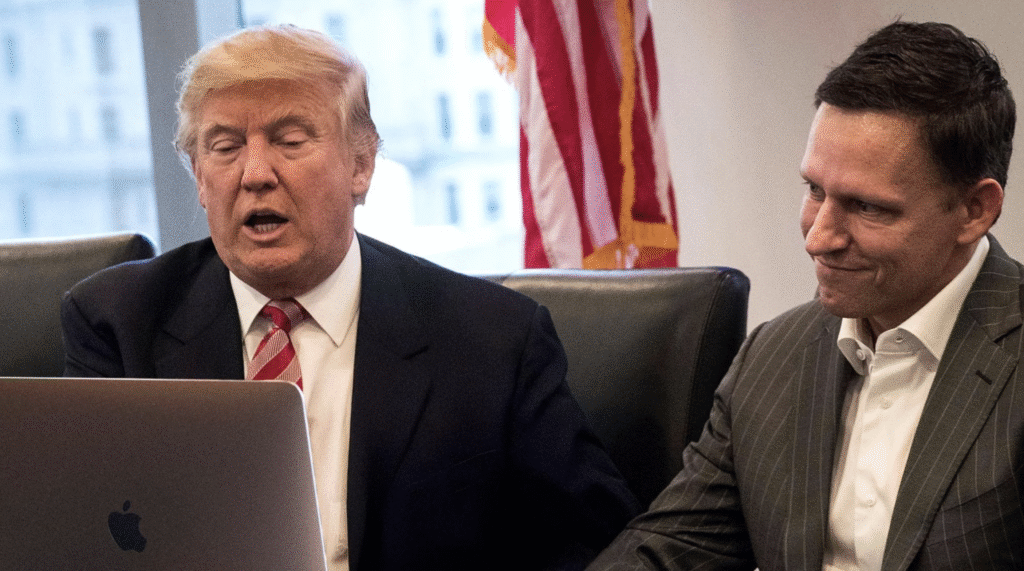
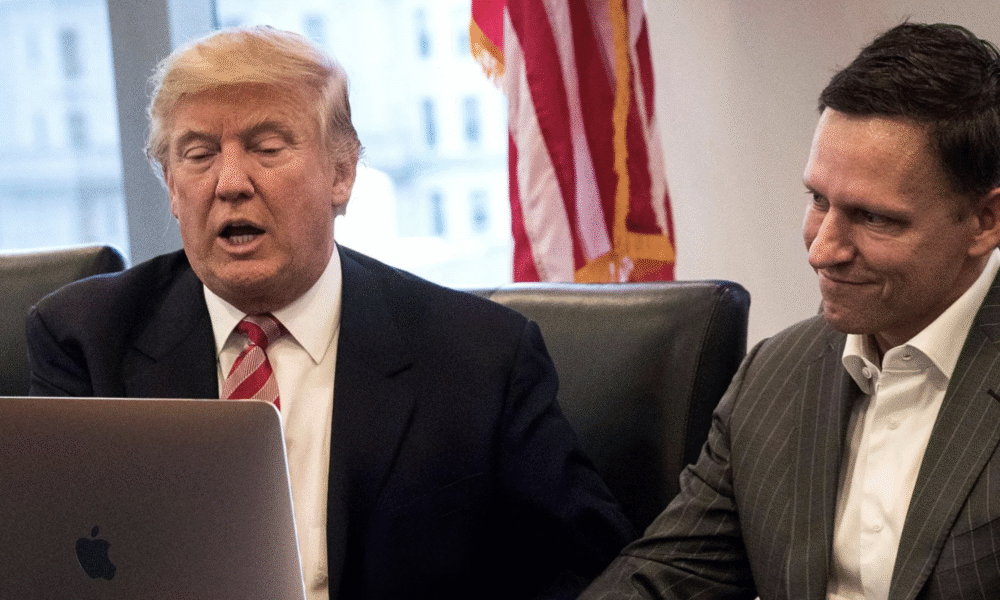
Donald Trump with Peter Thiel, Founder of Palantir
Vance Pushes Back: ‘It’s Not Surveillance’
At an event at the University of Mississippi, Vance bristled when asked if he was too close to Palantir.
“Palantir is a private company,” he said. “Sometimes they do useful services, and sometimes they’re going to do things we don’t like.”
He argues that tech giants collecting data for commercials pose a greater threat than Palantir’s government work—echoing Palantir CEO Alex Karp, who insists: “We are not a surveillance company.”
But critics say JD Vance’s responses are political rather than substantive.
A Growing GOP Divide
The controversy highlights a deeper and widening fracture inside the Republican Party—one between populist anti-tech voices and Trump’s growing alignment with Silicon Valley power players. Figures like Bannon, DeSantis, and Sen. Josh Hawley are all sounding alarms about Big Tech’s influence.
Yet Vance’s Silicon Valley fluency also makes him a potential future leader. Even Karp hinted that someone “like Vance” could carry Trump’s movement forward.
A High-Stakes Balancing Act
As the administration deepens its partnership with Palantir, Vance must navigate a political minefield: protect Trump’s tech alliances while calming a base that increasingly fears digital authoritarianism.
The question is no longer whether Vance has a Palantir problem— it’s whether the problem will define his political future.