







News
Trump Pressures Oil Giants to Cut Fuel Prices, Criticizes Chevron CEO

US President Donald Trump has renewed pressure on America’s largest energy companies to reduce gasoline prices, publicly criticizing Chevron CEO Mike Wirth while arguing that his administration’s policies have driven the oil industry’s recent success.
Trump’s latest comments come as fuel prices remain under close public scrutiny following months of volatility linked to the war of choice in Iran, geopolitical uncertainty in the Middle East, and concerns over global energy supplies. The issue has also emerged as a major political talking point ahead of the United States’ midterm elections, where inflation and the cost of living are expected to dominate voter concerns.
Trump Calls Out Chevron
In a strongly worded statement, Trump accused Chevron Chairman and Chief Executive Officer Mike Wirth of failing to acknowledge what he described as the administration’s role in strengthening the American oil industry.
Donald Trump argued that policy decisions made under his administration had helped create a more favorable environment for domestic energy producers and cited Chevron’s renewed operations in Venezuela as an example of the industry’s improved prospects.
Trump then broadened his criticism beyond Chevron, calling on the entire oil sector to reduce retail fuel prices immediately for American consumers.
“They should get consumer oil prices down now,” Trump said, reiterating a message he has delivered repeatedly over recent months.
The remarks underscore the administration’s continuing effort to present lower energy prices as a key economic priority.
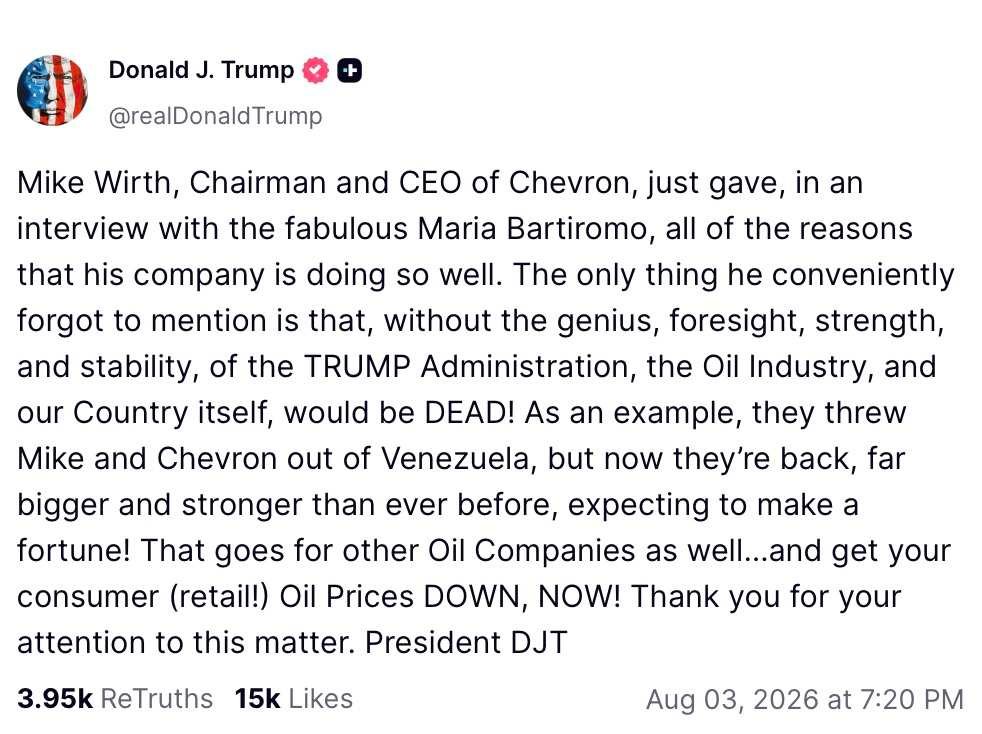
Trump Truth Social Post on Chevron CEO Mike Wirth
Oil Prices Ease After Iran Negotiation Signals
Trump’s comments coincided with a decline in global crude oil prices following indications that diplomatic discussions involving Iran could resume.
Brent crude, the international benchmark, fell roughly five percent during Monday’s trading session after Trump suggested that negotiations with Iran were imminent. The benchmark remained significantly below its recent highs recorded during the height of regional tensions, although prices continue to trade well above levels seen earlier in the year.
Energy markets have experienced sharp swings since the outbreak of hostilities involving Iran earlier this year, with investors closely monitoring developments around shipping lanes, production levels and geopolitical risks.
The Strait of Hormuz, one of the world’s most strategically important energy corridors, remains central to market concerns because a significant share of global oil exports passes through the narrow waterway.
Conflicting Signals on Iran Talks
While Trump expressed optimism about renewed diplomacy, officials in Tehran offered a different assessment of the situation.
Iranian Foreign Ministry spokesperson Esmaeil Baghaei stated that current discussions are limited to technical conversations regarding management of the Strait of Hormuz through Omani mediation. According to Iranian officials, no direct negotiations with the United States are currently taking place.
The contrasting statements reflect the uncertainty that has characterized diplomatic efforts throughout the crisis, with markets responding quickly to any indication of progress or renewed tensions.
Despite the recent decline, oil prices remain elevated compared with pre-conflict levels after supply concerns pushed crude significantly higher during the previous month.
Economic Pressure Ahead of Midterm Elections
Fuel prices have become an increasingly important political issue as Americans continue to face broader cost-of-living pressures.
Although the administration has frequently argued that energy prices will decline once regional tensions ease, several economists caution that geopolitical conflicts can have longer-lasting effects on global supply chains, refining capacity and transportation costs.
Analysts also note that while presidential statements can temporarily influence market sentiment, underlying supply-demand fundamentals ultimately determine long-term pricing.
Some market observers believe investors are now placing greater emphasis on actual developments in the Middle East than on political messaging, particularly as uncertainty persists regarding future military operations and diplomatic negotiations.
Oil Companies Face Mounting Scrutiny
The administration has repeatedly encouraged domestic producers to expand production while also urging refiners and retailers to pass on lower crude prices to consumers more quickly.
Industry executives, however, point out that retail gasoline prices depend on numerous factors beyond crude oil costs, including refining expenses, transportation, taxes, seasonal demand and regional supply conditions.
As a result, changes in international crude prices do not always translate immediately into lower prices at fuel stations.
Nevertheless, the White House continues to argue that major energy companies should do more to ease financial pressure on consumers.
Markets Watch Supply and Politics
Investors are expected to continue monitoring developments surrounding the Middle East conflict, negotiations over regional security, and production decisions by major oil-producing nations.
At the same time, political analysts say fuel prices are likely to remain a central campaign issue heading into the midterm elections, with both parties expected to focus heavily on inflation, household expenses and energy affordability.
Whether oil companies respond to the administration’s latest call remains uncertain, but Trump’s remarks signal that gasoline prices will remain firmly on the political agenda as the election season approaches.