










immigration Politics
Spain Deploys Troops to Ceuta After Thousands of Migrants Cross From Morocco
Italian Prime Minister Giorgia Meloni described the scenes in Ceuta as deeply concerning and suggested that Italy was examining extraordinary measures, including the possibility of suspending aspects of the Schengen open-border framework with Spain if migration pressures continue to intensify.

Spain has deployed military personnel to its North African enclave of Ceuta after thousands of migrants crossed into the territory from neighboring Morocco in one of the largest migration surges since the 2021 border crisis. The dramatic influx has strained local resources, intensified political debate across Europe, and renewed scrutiny of border management policies.
Spanish authorities confirmed that the armed forces would reinforce the Civil Guard to help restore order and strengthen security following the unprecedented wave of arrivals. The deployment comes after local officials warned that Ceuta’s reception facilities had been overwhelmed by the growing number of migrants attempting to enter the enclave.
Thousands Reach Ceuta as Dangerous Sea Crossings Turn Deadly
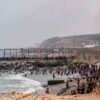
According to Spanish media reports, between 2,000 and 3,000 migrants entered Ceuta on Thursday, although officials have not released an official count. Many migrants reportedly bypassed border barriers by climbing down steep embankments and swimming around the breakwater separating Morocco from the Spanish territory.
The crossing proved deadly for many. At least 15 people are reported to have drowned while attempting to reach the enclave through the Mediterranean waters, underscoring the risks associated with irregular migration routes into Europe.
Images from the area showed beaches littered with discarded flotation devices, rubber rings, flippers, and clothing as exhausted migrants reached Spanish soil. Emergency services, police, and humanitarian organizations were mobilized to assist arrivals while authorities worked to restore control.
El Gobierno de España está volcado en dar una respuesta inmediata a la situación en Ceuta.
Estamos movilizando todos los recursos necesarios, trabajando con las autoridades marroquíes e internacionales, y preparando las medidas necesarias para recuperar la normalidad lo antes…
— Pedro Sánchez (@sanchezcastejon) July 30, 2026
Spain Orders Military Reinforcement
Spain’s Interior Ministry announced that military forces would support the Civil Guard in maintaining security throughout Ceuta.
Officials argued that recent legal developments have complicated border enforcement. Earlier this month, Spain’s Supreme Court ruled that migrants intercepted at sea while attempting to reach Ceuta or the nearby enclave of Melilla cannot automatically be returned to Morocco without legal procedures.
The Interior Ministry claimed that criminal smuggling organizations have exploited the ruling by encouraging more undocumented migrants to attempt the dangerous journey across the border.
Prime Minister Pedro Sánchez is expected to visit Ceuta as the government seeks to reassure residents and coordinate emergency measures aimed at stabilizing the situation.
View this post on Instagram
Local Authorities Warn of Humanitarian Pressure
Ceuta’s regional leadership has repeatedly appealed to Madrid for additional assistance as migrant arrivals increased over recent days.
Local officials say reception centers have exceeded capacity, leaving authorities struggling to provide emergency shelter, food, medical care, and registration services. The sudden influx has also placed added pressure on law enforcement personnel responsible for maintaining public order.
The Spanish enclave, located on Morocco’s northern coastline across the Strait of Gibraltar, represents one of the European Union’s only land borders with Africa and has long served as a focal point for migration into Europe.
Italy Raises Concerns Over Schengen Borders
The migration surge has quickly evolved into a broader European political issue.
Italian Prime Minister Giorgia Meloni described the scenes in Ceuta as deeply concerning and suggested that Italy was examining extraordinary measures, including the possibility of suspending aspects of the Schengen open-border framework with Spain if migration pressures continue to intensify.
Italian Foreign Minister Antonio Tajani also voiced concerns over Europe’s external border security.
Spain strongly rejected the remarks. Foreign Minister José Manuel Albares accused Italian leaders of politicizing migration and urged greater European solidarity instead of rhetoric that could inflame tensions between member states.
The Schengen Area allows passport-free travel across 29 European countries, making border management a shared responsibility among participating nations.
Le immagini che arrivano da Ceuta sono impressionanti e dimostrano, ancora una volta, che l’immigrazione clandestina fuori controllo rappresenta una minaccia concreta per la sicurezza dei confini europei.
Mi sono confrontata con il Ministro dell’Interno Matteo Piantedosi.…
— Giorgia Meloni (@GiorgiaMeloni) July 30, 2026
Questions Remain Over Morocco’s Border Response
Authorities have yet to explain what triggered the sudden collapse in migration controls along the Moroccan side of the border.
Witnesses in the Moroccan border town of Fnideq reported seeing security forces use water cannons to disperse crowds attempting to approach the frontier. There were also unconfirmed reports of disturbances near Melilla, Spain’s second autonomous enclave in North Africa.
Officials continue investigating whether organized trafficking networks coordinated the large-scale movement toward Ceuta.
Migration Crisis Rekindles Memories of 2021
The latest developments have revived comparisons with the May 2021 migration crisis, when approximately 8,000 migrants entered Ceuta within days, triggering diplomatic tensions between Spain and Morocco.
Since then, Spanish authorities have invested heavily in surveillance technology, reinforced border barriers, and expanded cooperation with Moroccan security agencies. Despite those measures, migration pressures continue to test Europe’s southern frontier.
The latest surge is expected to renew discussions within the European Union over migration policy, asylum procedures, border security, and cooperation with neighboring countries as governments seek long-term solutions to recurring humanitarian and security challenges.





















































Pingback: Iceland Rejects EU Talks After Bitter Referendum Battle