





Auto
Ferrari’s First EV Gets a Name—and a Game-Changing Interior Designed by Apple Legend Jony Ive

Ferrari has officially named its first all-electric car Luce, and while the exterior remains under wraps, the Italian marque has already revealed what may be the most talked-about cabin in modern automotive history. Designed by Sir Jony Ive, the former Apple design chief behind the iPhone and MacBook, the Luce’s interior signals a seismic shift in how performance cars may look, feel, and function in the electric era.
Why the Ferrari Luce Matters
The Luce represents phase two of Ferrari’s carefully staged EV reveal, and the focus on the interior is deliberate. In an age where screens dominate dashboards and software defines driving experiences, Ferrari has entrusted the human-machine interface to one of the most influential designers of the last half-century.
Jony Ive, working through his design collective LoveFrom alongside Marc Newson, partnered closely with Ferrari leadership to rethink not just how an electric Ferrari should operate, but also how it should feel. The result is a cabin rooted in driving purity rather than digital overload.
A Physical Interface in a Digital Age
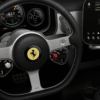
Unlike many modern EVs, the Ferrari Luce resists the temptation to go fully touchscreen. The cockpit prioritises physical, mechanical controls, with the steering wheel and instrument binnacle forming the core of the driving experience. According to Ive, this approach was built on first principles: output through the display, input through tactile controls.
Every switch, dial, and paddle has been engineered for intuitive use and haptic satisfaction. From torque delivery modes to regenerative braking, the Luce ensures that performance adjustments remain immediate and distraction-free.
View this post on Instagram
Materials, Craftsmanship, and Obsession
Ferrari and Jony Ive’s LoveFrom treated the interior like a collection of precision instruments rather than trim pieces. Anodised aluminium dominates the cabin, CNC-milled from solid billets for strength, lightness, and visual purity. Notably, plastic is virtually absent, underscoring Ferrari’s commitment to longevity and craftsmanship.
The 12.86-inch instrument display blends analogue inspiration with advanced OLED technology developed with Samsung. Physical needles, backlit by LEDs, reference classic Ferrari gauges while reducing cognitive load for the driver. Even the screws are designed to be visually satisfying—an Apple hallmark carried into automotive design.
Designed to Last, Not Age
One of the most radical ideas behind the Ferrari Luce interior is its resistance to obsolescence. While consumer electronics often feel outdated within years, Ferrari’s EV aims for timelessness. Glass components developed with Corning, aviation-inspired controls, and watch-like mechanical elements reinforce the idea that this is not disposable technology.
The central screen even pivots smoothly between driver and passenger, complete with a palm rest to ensure controlled interaction—an elegant solution rarely seen in cars.
A New Chapter for Ferrari
Ferrari executives describe the Luce as more than just an electric car. It is a cultural crossover between automotive engineering and consumer technology, built on trust, collaboration, and shared values.
As Ferrari prepares to unveil the exterior later this year, one thing is already clear: the Luce is not chasing trends. It is redefining expectations—quietly, precisely, and with unmistakable confidence.