










Samsung Hits $1 Trillion Valuation as AI Boom Sparks Record Stock Surge
The company is also reportedly in exploratory talks with Apple and Intel to manufacture chips for future devices in the United States. Such a move could diversify supply chains and reduce reliance on traditional manufacturing partners.
Samsung Electronics has crossed the $1 trillion market valuation mark, fueled by a powerful rally in artificial intelligence (AI)-linked stocks. Shares surged more than 15% in a single day, marking one of the company’s biggest gains on record and pushing its stock price to an all-time high.
This milestone places Samsung among an elite group of global tech giants and makes it only the second Asian company, after TSMC, to achieve the trillion-dollar valuation benchmark.
Record Earnings Drive Investor Confidence
The rally follows a blockbuster first-quarter earnings report that exceeded expectations across the board. Samsung posted an operating profit of 57.2 trillion won, more than eight times higher than the previous year, while revenue hit a record 133.9 trillion won.
In a striking development, the company’s first-quarter profit alone surpassed its entire profit for 2025, underscoring the scale of its recent growth. Analysts attribute this surge to skyrocketing demand for AI infrastructure, which relies heavily on advanced semiconductor technology.
AI Memory Boom Fuels Semiconductor Demand
At the heart of Samsung’s growth is its dominance in memory chips, particularly high-bandwidth memory (HBM), which is essential for AI workloads. The company recently announced mass production of HBM4 chips, the latest generation of memory technology expected to power next-gen AI systems, including those from Nvidia.
HBM chips are crucial for handling massive data flows in AI applications, making them a cornerstone of the current tech boom. Analysts say a global shortage of DRAM and NAND memory—key components in computing—has further driven up prices and profitability.
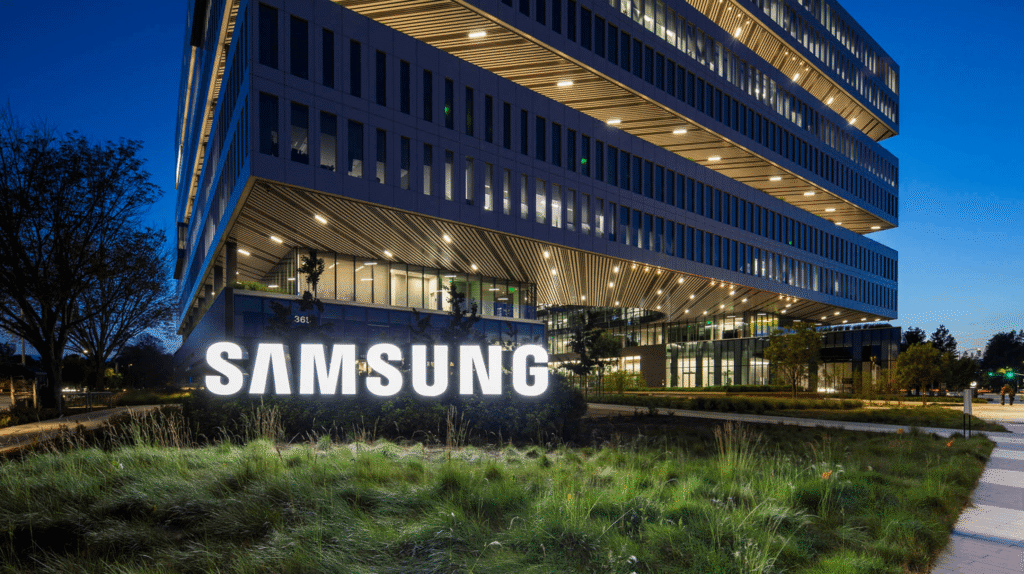
Samsung Electronics HQ
Competition Heats Up in AI Chip Race
Despite its success, Samsung faces stiff competition from SK Hynix, which currently leads the HBM market with a larger share. However, Samsung is rapidly closing the gap with technological advancements and strong customer feedback on its latest products.
The company is also reportedly in exploratory talks with Apple and Intel to manufacture chips for future devices in the United States. Such a move could diversify supply chains and reduce reliance on traditional manufacturing partners.
Market Ripple Effects and Future Outlook
Samsung’s surge has had a broader impact on markets, with South Korea’s Kospi index rising more than 5% to cross the 7,000 mark for the first time. Shares of SK Hynix also jumped over 10%, reflecting strong investor confidence in the semiconductor sector.
Experts believe the AI-driven demand for memory chips will remain robust in the near term. With new semiconductor manufacturing capacity taking years to develop, supply constraints are expected to persist, supporting higher prices and profit margins.
Samsung’s trillion-dollar milestone highlights the transformative impact of artificial intelligence on global markets. As demand for AI infrastructure accelerates, companies at the forefront of semiconductor innovation are poised for sustained growth.
With continued investment in cutting-edge memory technology and strategic global partnerships, Samsung appears well-positioned to remain a dominant force in the evolving AI ecosystem.