








News
Trump Threatens US Troop Cuts in Germany after Merz Iran Humiliation remarks
Chancellor Friedrich Merz offered a sharp assessment of US strategy in its ongoing ceasefire negotiations with Iran, suggesting that Iranian negotiators had successfully run out the clock on American diplomats, allowing the US delegation to travel to Islamabad and return without any meaningful outcome.

Donald Trump is miffed by the comments of German Chancellor Friedrich Merz over the Iran war, which has led him to announce that the United States is actively reviewing a possible reduction of its military forces in Germany. This move would have significant implications for NATO’s European posture and transatlantic relations at an already tense moment in global diplomacy.
Trump announced his Truth Social platform, stating that the US is studying and reviewing a possible reduction of troops in Germany and that a determination would be made in a short period of time. The post was brief, but its implications have been immediately felt in European capitals.
The Scale of the US military presence in Germany
Germany hosts more US military personnel than any other country in Europe. As of December 2025, more than 36,000 active service members were stationed across the country, spread across five of the seven US garrisons on the continent. That number includes personnel at Ramstein Air Base in southwestern Germany, the largest US overseas air force installation in the world, and a facility that has played a central operational role in US military activities, including those connected to the ongoing Middle East conflict.
The United Kingdom and Italy host the next largest concentrations of US forces in Europe, but neither comes close to Germany’s scale.
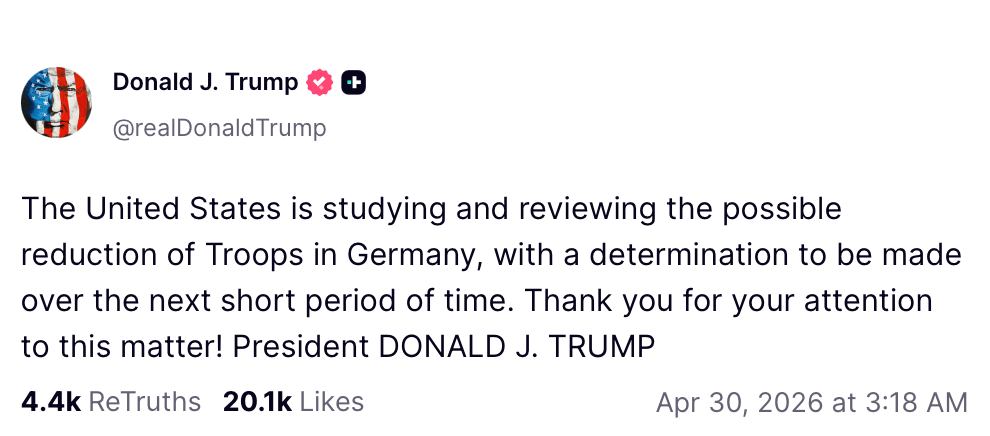
Trump’s Post on Germany
What Triggered the Announcement
The timing of Trump’s post is directly connected to remarks made by German Chancellor Friedrich Merz earlier this week. Addressing university students in Marsberg on Monday, Chancellor Friedrich Merz offered a sharp assessment of US strategy in its ongoing ceasefire negotiations with Iran, suggesting that Iranian negotiators had successfully run out the clock on American diplomats, allowing the US delegation to travel to Islamabad and return without any meaningful outcome.
Merz described the situation as humiliating for the United States, characterising Iran’s Revolutionary Guards as having outmanoeuvred Washington at the negotiating table and calling for a swift resolution.
Trump responded the following day, dismissing Merz’s analysis and accusing the German chancellor of failing to understand the situation, including, according to Trump’s post, being comfortable with Iran acquiring a nuclear weapon. Merz’s office subsequently clarified that his remarks were directed at Iran’s behaviour rather than at the United States itself, with German Foreign Minister Johann Wadephul stressing that the chancellor’s words had been misread.
Germany’s President Condemns Iran War, Signals Strained U.S. Relations
The Broader Strategic Context
Trump’s troop reduction threat arrives against a backdrop of longstanding tensions over European defence spending and burden-sharing within NATO. Germany has previously been a target of Trump’s criticism over what he has characterised as insufficient contributions to collective defence, a dynamic that has periodically strained the bilateral relationship throughout his political career.
Whether the announcement represents a genuine policy intention or a pressure tactic directed at both Berlin and Tehran remains unclear. The White House had not issued a formal comment at the time of publication.
What is clear is that floating the possibility of withdrawing 36,000 troops from Europe’s most strategically significant US military hub, even as a contingency, carries considerable weight. European allies will be watching closely for any further signals from Washington.
































Pingback: Trump Pulls 5,000 Troops From Germany, NATO Shift Inevitable
Pingback: Germany Misses Out on Key UN Security Council Seat
Pingback: Germany’s Far Right AfD Wins 44% of the Vote in Germany