










News
Appeals Court Rejects Trump’s Bid to Rehear E. Jean Carroll Verdict

A federal appeals court has denied Donald Trump’s request to rehear his appeal in the high-profile defamation case brought by writer E. Jean Carroll. The decision leaves intact the $83 million judgment awarded to Carroll and marks another significant development in a case that has drawn national attention.
The ruling came from the U.S. Court of Appeals for the Second Circuit, where a majority of judges declined to grant an “en banc” hearing, a review by the full bench of the court.
Background of the Case
The legal battle stems from a 2024 jury verdict that found Trump liable for defaming Jean Carroll after he publicly denied her allegation that he sexually assaulted her in the 1990s. Carroll’s claim, first made public in 2019, led to multiple lawsuits and years of legal proceedings.
Trump has consistently denied the allegations and any wrongdoing, describing the claims as false. However, the jury concluded that his statements went beyond denial and constituted defamation.
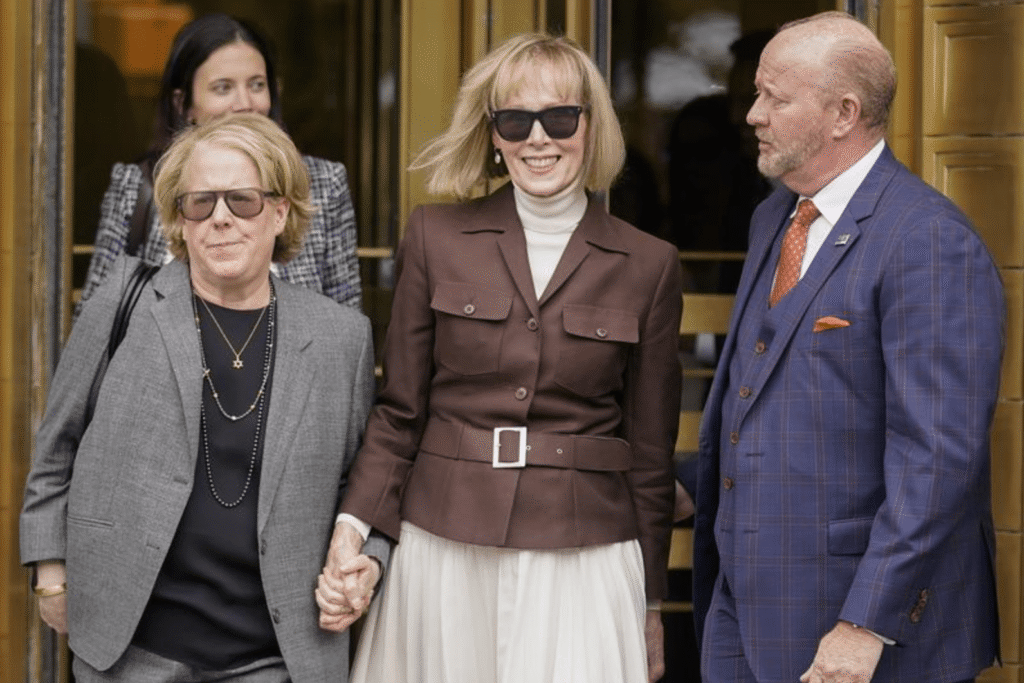
E. Jean Carroll (center) in 2023
Court Rejects Immunity Argument
Central to Trump’s appeal was the argument of presidential immunity. His legal team sought to substitute the United States as the defendant, arguing that his statements were made in an official capacity while serving as president.
The appeals court rejected this claim, stating that such a substitution would not be permitted under normal legal standards. Judge Denny Chin emphasized that no other defendant would be allowed to make such a request long after a trial and judgment had been finalized.
The court’s refusal to revisit the issue effectively shuts down this line of defense at the appellate level.
Split Decision Highlights Legal Debate
While the majority denied the rehearing, the decision was not unanimous. A dissenting opinion argued that the case raises significant constitutional questions about the scope of presidential duties and immunity.
Judge Steven J. Menashi, in dissent, suggested that the case warranted further review to align with Supreme Court precedent and clarify the limits of executive authority.
Despite this disagreement, the majority ruling stands, reinforcing the original judgment in Carroll’s favor.
The Supreme Court?
With the appeals court rejecting his request, Trump’s legal team is expected to take the case to the Supreme Court of the United States. The move would shift the focus to whether the nation’s highest court is willing to weigh in on the broader constitutional questions raised by the case.
Trump’s representatives have criticized the ruling, framing it as part of a politically motivated legal campaign. Meanwhile, E. Jean Carroll’s legal team welcomed the decision, expressing hope that the long-running case is nearing its conclusion.
Broader Implications
The case carries implications beyond the individuals involved, particularly in defining the limits of presidential immunity in civil litigation. Legal experts suggest that the outcome could influence how future cases involving public officials are handled.
Additionally, the ruling underscores the judiciary’s role in balancing claims of executive authority against accountability under the law.
As the case potentially heads to the Supreme Court, it remains a defining moment in the intersection of law, politics, and accountability. For now, the appeals court’s decision reinforces the jury’s verdict and keeps the spotlight firmly on one of the most closely watched legal battles in recent years.















































Pingback: DOJ Targets Trump Accuser E. Jean Carroll in New Investigation