




News
Trump Slams Bad Bunny’s Super Bowl Halftime Show, Igniting Culture War Debate

Donald Trump has sparked fresh controversy after publicly criticizing Bad Bunny’s Super Bowl LX halftime show, calling the performance “a slap in the face to America” in a fiery post shared on Truth Social following Sunday night’s game.
The remarks came shortly after the Puerto Rican superstar concluded his halftime set at Levi’s Stadium in Santa Clara, California, a performance watched by millions worldwide and praised across social media for its cultural representation and musical ambition.
Trump’s Blistering Reaction Goes Viral
In his post, Trump dismissed the halftime show as one of the worst in Super Bowl history, arguing that it failed to reflect what he described as American values of excellence and creativity. He also took aim at Bad Bunny’s Spanish-language performance, claiming viewers could not understand the lyrics and criticizing the choreography as inappropriate for family audiences.
Trump further used the moment to highlight economic talking points and criticize media coverage, asserting that positive reviews would come from outlets disconnected from everyday Americans. He concluded by reiterating his opposition to the NFL’s updated kickoff rule, a frequent target of his criticism.
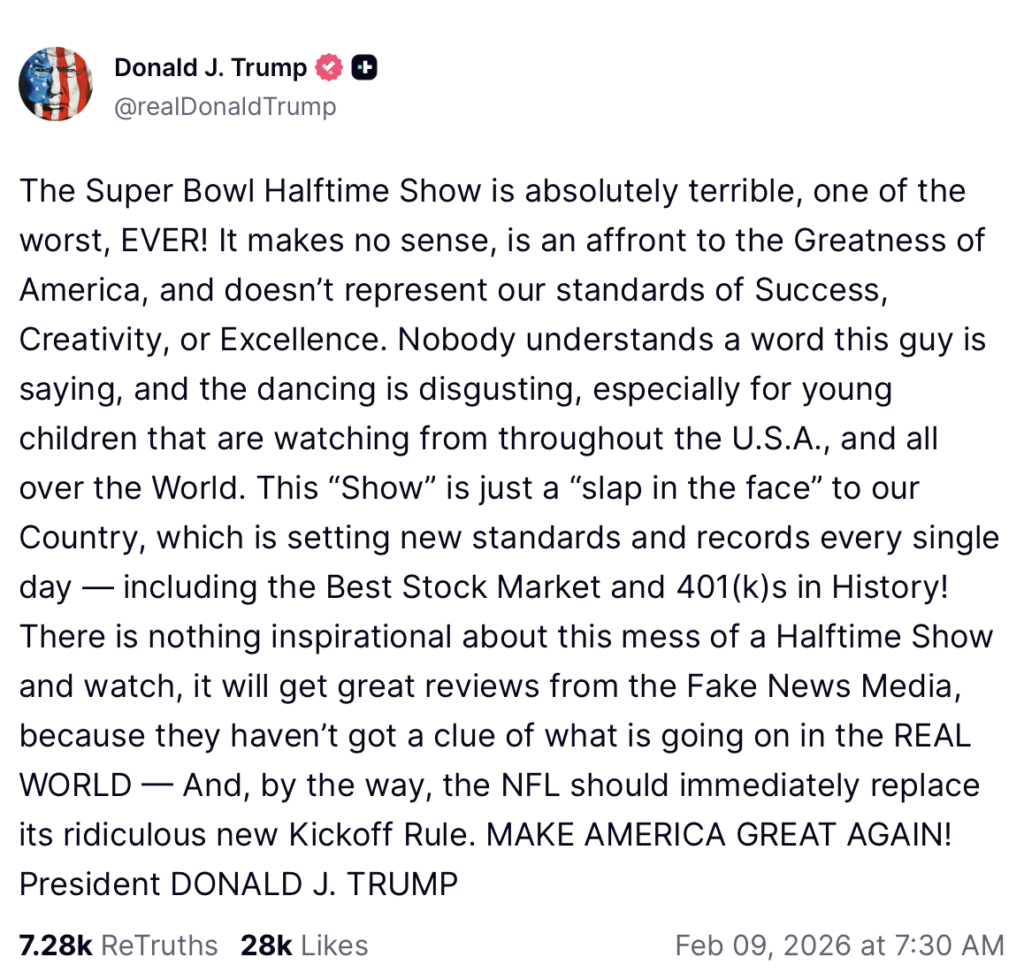
Trump on Truth Social, criticizing Bad Bunny’s Super Bowl LX halftime show
A Performance Rooted in Cultural Identity
Bad Bunny’s halftime show marked one of the most culturally specific performances in Super Bowl history, drawing heavily from Puerto Rican heritage, reggaeton, Latin trap, and Caribbean rhythms. The set featured large-scale choreography and surprise appearances by Lady Gaga and Ricky Martin, with additional celebrity cameos fueling online buzz.
Despite political backlash, clips from the show quickly trended across TikTok, Instagram, and X, with fans praising its energy, representation, and global appeal.
View this post on Instagram
Bad Bunny’s Global Impact on Music
Born Benito Antonio Martínez Ocasio, Bad Bunny has been one of the most influential artists of the past decade. He has topped the Billboard 200 multiple times and played a major role in bringing Spanish-language music into the U.S. mainstream, reshaping consumption patterns for pop and hip-hop.
His selection as the Super Bowl halftime performer reflected the NFL’s ongoing effort to appeal to international and multicultural audiences, a strategy that has intensified since Apple Music became the official halftime sponsor in partnership with Jay-Z’s Roc Nation.
Political and Cultural Backlash Intensifies
Trump’s comments reignited criticism from conservative commentators who argue the NFL has moved too far toward global and multilingual programming. Some groups questioned Bad Bunny’s role as a cultural representative, despite Puerto Ricans holding U.S. citizenship.
The backlash was strong enough that a right-wing organization staged an alternative “All-American Halftime Show,” featuring English-language performers and patriotic themes, underscoring the growing cultural divide surrounding major entertainment events.
As of publication, Bad Bunny has not publicly responded to the president’s remarks. However, early audience reception suggests the performance resonated with fans, reinforcing the NFL’s push toward broader cultural inclusion — even as it draws political fire.




























Pingback: Trump Calls US Olympian Hunter Hess ‘Real Loser’
Pingback: Why Drake Said No to Joining Bad Bunny at the Super Bowl
Pingback: Kid Rock vs Bad Bunny: Culture War Moves to Super Bowl Stage
Pingback: Jake Paul Calls Halftime Boycott, Logan Paul Defends Bad Bunny
Pingback: From the Super Bowl to Tokyo: Bad Bunny’s Global Takeover