








News
US and Iran Exchange New Strikes Across Middle East as Ceasefire Teeters on Collapse

Tensions between the United States and Iran intensified dramatically after both countries launched fresh military strikes across the Middle East for a second consecutive day, raising concerns that a fragile ceasefire agreement could be nearing collapse.
The latest exchanges come amid growing instability in the region, with military activity reported in Iran, Jordan, Bahrain, Kuwait, and strategic waterways near the Strait of Hormuz. The renewed hostilities have sparked international concern over the potential impact on global security and energy markets.
US Launches “Self-Defense” Strikes
According to U.S. Central Command (CENTCOM), American forces carried out what were described as “self-defense strikes” against military infrastructure in southern Iran. The operation reportedly targeted surveillance systems, radar installations, and military facilities believed to pose threats to U.S. forces and regional allies.
The strikes followed strong remarks from Donald Trump, who warned that the United States would continue responding forcefully to Iranian actions.
Defense officials argued that Tehran had failed to engage meaningfully in ongoing diplomatic efforts, prompting a military response aimed at deterring future attacks.
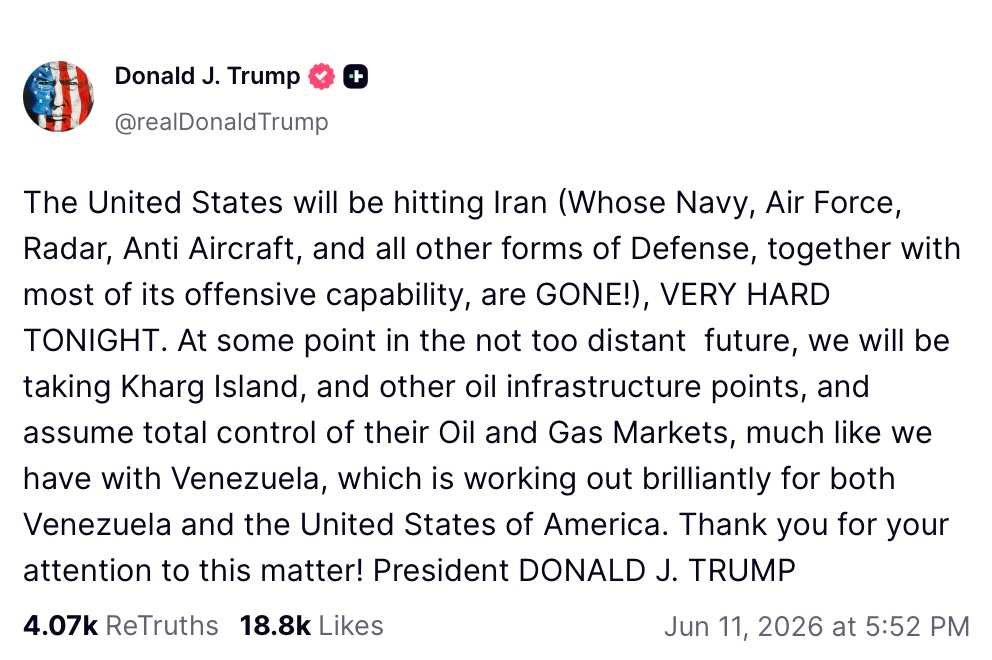
Trump Threats to Iran on His Private Social Media
Iran Retaliates Across the Region
Iran responded with missile and drone attacks targeting U.S.-linked military assets in several Middle Eastern countries, including Bahrain, Kuwait, and Jordan.
The Islamic Revolutionary Guard Corps (IRGC) claimed responsibility for ballistic missile launches aimed at military facilities in Jordan. Iranian state media reported that several targets were struck, though Jordanian authorities said their air defense systems intercepted multiple incoming missiles before they could cause damage.
Jordanian officials stated that no casualties or significant property losses were reported.
Meanwhile, Bahrain activated air raid sirens after debris from intercepted drones reportedly damaged homes and vehicles. Authorities confirmed that one child suffered minor injuries during the incident.
Kuwait also reported intercepting aerial threats and temporarily closed its airspace before resuming normal operations.
A World Cup stained by bombing and killing. pic.twitter.com/78z3sS1EEM
— Iran Embassy SA (@IraninSA) June 10, 2026
Strait of Hormuz Remains in Focus
The situation has also drawn attention to the Strait of Hormuz, one of the world’s most important energy transit routes.
Iranian media reported disruptions in maritime traffic and claimed military actions had targeted vessels in the region. The IRGC said two oil tankers were struck, though independent confirmation remained unavailable.
U.S. officials disputed reports of a full closure of the Strait, stating that commercial shipping continued to operate through the waterway.
The Strait of Hormuz carries a significant portion of the world’s oil and liquefied natural gas exports, making any disruption a major concern for international markets.
Oil Prices Climb Amid Uncertainty
Energy markets reacted quickly to the escalating conflict.
Brent crude oil prices surged toward $95 per barrel as traders assessed the possibility of prolonged disruptions to global energy supplies. Analysts warned that continued military escalation could place additional pressure on already volatile oil markets.
The rising prices reflect investor concerns over shipping security and the broader economic consequences of instability in the Gulf region.
Diplomatic Efforts Under Pressure
Iran’s foreign ministry accused Washington of undermining diplomatic progress and declared that the recent attacks had effectively rendered the existing ceasefire “meaningless.”
Iranian President Masoud Pezeshkian vowed that the country would resist external pressure, while U.S. officials maintained that military action would continue if threats persisted.
With both sides exchanging accusations and military strikes, hopes for a negotiated settlement appear increasingly uncertain. International observers are urging restraint as fears grow that the conflict could expand beyond its current scope and draw additional regional actors into the confrontation.