News
Hayli Gubbi Volcano Erupts for the First Time in Recorded History, Sending Ash Across East Africa and Arabia

In a dramatic and unprecedented geological event, Ethiopia’s Hayli Gubbi volcano — dormant for nearly 10,000 years — erupted explosively on Sunday morning, marking the first eruption in its recorded history. The volcano, situated in the Afar Rift’s Erta Ale range, awoke without warning, sending shockwaves through the scientific community and prompting aviation alerts across multiple countries.
Satellite data captured the eruption around 08:30 a.m. local time, revealing a massive ash plume rising 10–15 km (up to 45,000 feet) into the atmosphere. The plume drifted across the Red Sea toward Oman, Yemen, Djibouti, and farther east toward Pakistan, Iran, and India, according to updates from the Toulouse Volcanic Ash Advisory Center (VAAC).
Satellite Images Reveal Scale of the Blast
Because Hayli Gubbi lies in one of the most remote, inhospitable regions on Earth, satellite imagery has become the primary source of real-time information. Images shared by volcanologists Prof. Simon Carn and Dr. Erik Klemetti show a towering ash column and a significant sulfur dioxide (SO2) plume, signaling a powerful and sustained eruption.
Experts note that the eruption’s force and elevation made it immediately visible on global satellite systems — a rare event for a volcano with no previously documented explosive activity.

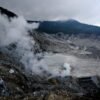
Ethiopia’s Hayli Gubbi Volcano
A Geological Mystery Wakes Up
Hayli Gubbi sits roughly 15 km southeast of the famously active Erta Ale volcano, known for its persistent lava lake. Unlike its volatile neighbor, Hayli Gubbi had no modern eruption record and was long considered dormant. Geological studies in the region are sparse due to extreme heat, remoteness, and limited access, leaving scientists uncertain about the volcano’s full history.
The sudden eruption suggests a long repose period, potentially spanning thousands of years — a fact that makes the event even more extraordinary.
Aviation Alerts Issued, No Damage Reported
VAAC issued immediate flight advisories after the ash cloud reached cruising altitudes used by commercial aircraft. While ash drifted toward major air corridors over the Arabian Peninsula and the Indian subcontinent, no significant flight disruptions or local damage have been reported so far. Lower-level ash continued moving across the Red Sea throughout Sunday.
Despite the eruption’s size, the surrounding region remains sparsely populated, reducing the risk of direct community impact.
As of the latest VAAC update, explosive activity has decreased, but monitoring continues. Scientists will be analyzing satellite data over the coming days to determine whether the eruption marks a brief explosive pulse or the beginning of a longer eruptive phase.
The eruption also highlights the dynamic, unpredictable nature of the Afar Rift — one of the world’s most active and scientifically important volcanic regions.