









Environment & Nature
Scientists Discover Rare New Monkey Species Hidden in Congo Rainforest

Scientists have officially identified a previously unknown monkey species living deep within the rainforests of the Democratic Republic of the Congo (DRC), marking one of Africa’s most significant wildlife discoveries in decades.
The newly classified primate, scientifically named Colobus congoensis and locally known as Likweli, is only the fifth new African monkey species to be formally identified in the last 75 years. Researchers say the discovery highlights both the extraordinary biodiversity of the Congo Basin and the urgent need to protect its fragile ecosystems.
The findings have been published in the peer-reviewed journal PLOS One following years of fieldwork, genetic analysis, photography, and audio recordings.
A Monkey Hidden High in the Canopy
Likweli inhabits the dense forests of Lomami National Park in central-eastern DRC, where it spends much of its time in the upper forest canopy.
Conservationists first spotted the unusual monkey in 2008 but managed to capture only a blurry image. Another confirmed sighting a decade later prompted researchers from the Democratic Republic of the Congo, the United States, and Germany to launch a dedicated expedition in 2020.
Using camera equipment, sound recordings, and DNA analysis, the team confirmed that the primate represented a genetically distinct species closely related to the black colobus monkey.
The species derives its scientific name from the country where it was discovered, recognising the Congo’s remarkable natural heritage.
Distinctive Orange Lips Set It Apart
Unlike other members of the colobus family, Likweli is easily recognised by the striking ring of pinkish-orange fur surrounding its mouth. Researchers noted that when the monkey emits its characteristic roaring call, its lips form a distinctive pale orange circle, making it one of the species’ most identifiable features.
Scientists also observed behavioural traits that distinguish Likweli from many other African primates.
Rather than fleeing immediately when humans approach, groups often climb higher into the trees and quietly watch researchers for extended periods.
According to members of the research team, encounters frequently lasted over an hour, creating an unusual sense of mutual observation between scientists and the animals.
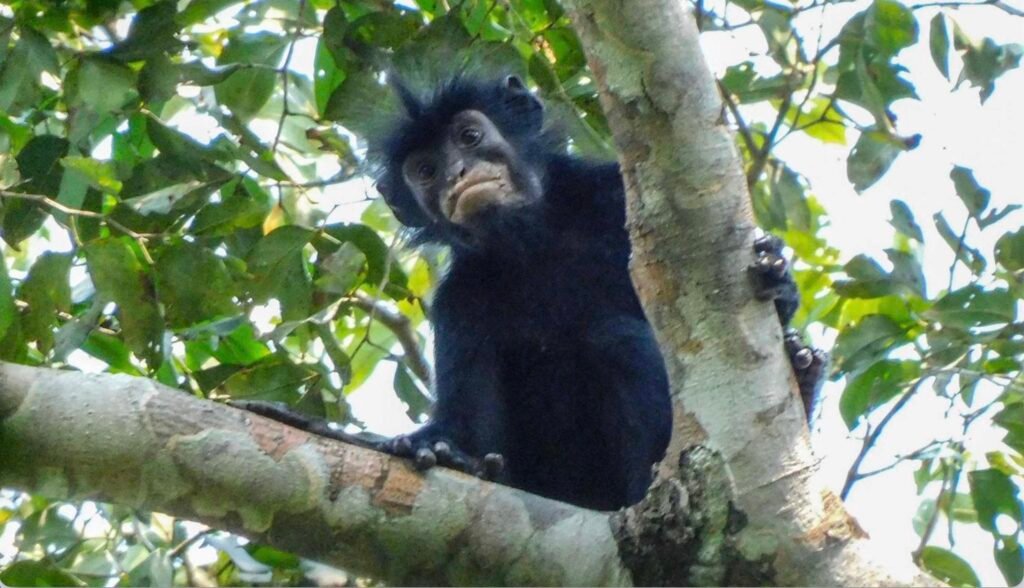
New Monkey Species Hidden in Congo Rainforest – Likweli (Colobus Congoensis)
Rare Species Faces Conservation Threats
Researchers estimate that Likweli occupies a limited forest range of roughly 650 square miles between the Lomami and Lilo rivers.
Its restricted habitat, combined with low population numbers, has prompted scientists to recommend that the species be classified as Endangered.
The monkeys are believed to exist only in scattered groups, and interviews conducted across 52 nearby villages found that residents in just eight communities had ever reported seeing them.
The species also faces pressure from bushmeat hunting, making conservation measures increasingly urgent.
Scientists hope that formal recognition of the monkey as a separate species will strengthen legal protections and attract greater conservation support.
Important Role in Forest Ecosystem
Likweli belongs to the colobus monkey family, primates known for their specialised herbivorous diets and their lack of thumbs.
These canopy-dwelling monkeys play a crucial ecological role by consuming leaves and dispersing seeds throughout tropical forests, contributing to natural regeneration and biodiversity.
Researchers believe the monkey’s vivid facial markings may serve as visual signals used for social recognition or mate selection, although further behavioural studies are planned to confirm these theories.
Its deep, resonant roaring calls also make the species easier to hear than to see, as the animals remain hidden high above the forest floor.
Discovery Highlights Congo’s Biodiversity
The identification of Colobus congoensis underscores how much of the Congo Basin’s wildlife remains undocumented despite decades of scientific exploration.
Researchers say the discovery serves as a reminder that significant new species can still be found in remote tropical forests, even as habitat loss and hunting threaten many of them before they are fully understood.
Future expeditions will focus on estimating Likweli’s population size, mapping its full distribution and studying its behaviour to support long-term conservation planning.
The discovery adds another remarkable chapter to Africa’s rich natural history while reinforcing calls to preserve one of the world’s most important rainforest ecosystems.